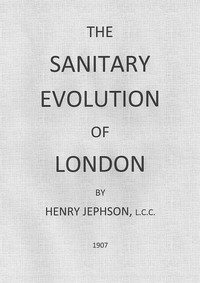
The Sanitary Evolution of London — Themes and Context

(0 User reviews)   1141
In Category - Public Health
Jephson, Henry (Henry Lorenzo), 1844-1914 Project Gutenberg 2014 Not confirmed
Public health -- England -- London Readers of public-domain and historical texts
Project Gutenberg digital edition en

Edition facts

Words 146,353
Reading time 637 min
Text sections 30

For The Sanitary Evolution of London — Themes and Context, the stored edition analysis reports 146,353 words, 10 hr 37 min estimated reading time, and 30 detected text sections.

The text analysis averages about 27.7 words per sentence, while the detected sections provide another way to judge how the source is divided.

Project Gutenberg metadata also associates the work with “Public health -- England -- London,” connecting these edition facts with the source record’s subject description.

Henry Jephson's 1907 study examines London's sanitary reforms through official reports and medical officer testimonies, revealing how cheap construction and inadequate drainage endangered public health in the late 19th century.
Share
Editorial Edition Score 4.9/5

Calculated from edition completeness, EPUB availability, text structure and catalogue metadata. Not a user rating.

How this score is calculated
  • Description quality20 pts
  • Title & short description10 pts
  • Source metadata20 pts
  • Text length15 pts
  • Chapters / structure15 pts
  • EPUB file integrity20 pts

Total of 100 points, scaled to a 2.5-5.0 range. Editions with an empty description or a missing EPUB file are not scored.

Edition quality

Public-domain source text

Read the source text

The source text is kept in the dedicated reader, separate from this catalogue record and its commentary.

Henry Jephson opens The Sanitary Evolution of London with a sweeping claim: the health of the people determines national strength, mental vigour, and even moral character. But the excerpts that follow quickly shift from this grand declaration to a gritty, evidence-driven account of how London's rapid building boom created a public health crisis. Drawing on reports from Medical Officers of Health and Select Committee testimonies, Jephson documents houses built on rubbish heaps, drains laid without cement, and basements flooded with cesspool matter. The book is less a narrative of progress than a catalogue of systemic failures, anchored in the words of contemporary officials.

Building on Filth: The Physical Evidence

The excerpts repeatedly return to one disturbing detail: new houses were often erected on ground filled with refuse. A witness before a Select Committee in 1874 described foundations made of manure, old boots, and old hats. The Medical Officer of Health for Poplar reported in 1873 that gravel was dug out and replaced with road-sweepings and dust-yard siftings. In Hackney, ten acres of houses sat atop a great dust heap. Jephson does not merely assert these facts; he lets the officials speak, creating a chorus of local testimony that makes the problem tangible. The consistency of these accounts across different districts—Poplar, Hackney, Wandsworth—suggests a citywide pattern of corner-cutting in construction.

Drains and Disease: The Infrastructure Gap

Even when buildings stood on solid ground, their drainage was often dangerously flawed. The Medical Officer of Health for Shoreditch noted in 1876–77 that many new drains had leaking joints, with pipes connected at right angles and neither cement nor clay used. An eminent civil engineer told a committee that 90 per cent of houses were imperfectly drained, with joints left uncemented. In Fulham, basements built below sewer level caused constant floodings of cesspool matter. Jephson’s use of these technical details—right angles, uncemented joints—gives the reader a concrete sense of the failures. The cumulative effect is a portrait of a regulatory vacuum: until near the end of the 1871–1881 decade, no authority could inspect building materials or stop dangerous construction.

The Voice of the Medical Officer

Jephson’s primary sources are the annual reports of London’s Medical Officers of Health. These officials emerge as the book’s key witnesses, their dry, factual prose carrying the weight of evidence. The Medical Officer of Health for Whitechapel summed up the attitude of builders in 1880: “the only thing that appears to be considered is that of cheapness.” Another officer described houses built of soft, ill-burnt bricks, tenanted before completion, with damp walls and unpaved streets. Jephson rarely editorializes; he lets these voices accumulate. The result is a work that feels more like a documentary record than a narrative history, grounded in the specific observations of men who walked the streets and inspected the drains.

Readers should approach The Sanitary Evolution of London as a compilation of primary evidence rather than a polished history. Jephson’s method is to present official reports and testimonies with minimal commentary, allowing the Medical Officers of Health to make the case for reform. The book is most valuable for its raw data—the dates, districts, and specific complaints that reveal how deeply poor construction and inadequate drainage affected London’s poor. Those seeking a broader narrative of sanitary progress will need to look elsewhere; this is a work of documentation, not synthesis.

I’ve spent many quiet evenings with Henry Jephson’s account of London’s drainage, that slow, gritty triumph of public health over stubborn neglect. It made me think of The Works of William Harvey M.D. Translated from the Latin with a life of the author — Inside the Classic, another learned struggle to see how the body truly works beneath the surface. Both books share that same patient reverence for hidden, vital circulation.

There are no reviews for this eBook.

0
0 out of 5 (0 User reviews )

Add a Review

Your Rating *
There are no comments for this eBook.

Reader reflection

How did this book work for you?

Your answers remain private and are stored only in this browser.

Your progress 0 / 10
1

Which reading stage best describes you?

2

Did this book hold your interest?

3

Would you encourage someone else to read it?

4

Did the language feel accessible?

Related eBooks