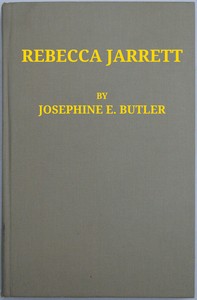
Rebecca Jarrett — Edition Insights
Edition facts
Before opening Rebecca Jarrett — Edition Insights, the edition data offers a quick orientation: 16,979 words, 1 hr 14 min estimated reading time, and 3 detected text sections.
The text analysis averages about 23.7 words per sentence, while the detected sections provide another way to judge how the source is divided.
Project Gutenberg metadata also associates the work with “Jarrett, Rebecca, 1846-1928,” connecting these edition facts with the source record’s subject description.
Calculated from edition completeness, EPUB availability, text structure and catalogue metadata. Not a user rating.
How this score is calculated
- Description quality20 pts
- Title & short description10 pts
- Source metadata20 pts
- Text length15 pts
- Chapters / structure15 pts
- EPUB file integrity20 pts
Total of 100 points, scaled to a 2.5-5.0 range. Editions with an empty description or a missing EPUB file are not scored.
Public-domain source text
Read the source text
The source text is kept in the dedicated reader, separate from this catalogue record and its commentary.
Josephine Butler opens her account of Rebecca Jarrett not with biography but with a courtroom aftermath: 'The trial is over. Our tongues are now loosed; and we can speak.' The trial in question is the 1885 prosecution of W.T. Stead, in which Jarrett—a former brothel-keeper turned rescue worker—was a central witness. Butler writes explicitly to counter the portrait of Jarrett that appeared in London newspaper 'leaders' the morning after the verdict. She acknowledges Jarrett's admitted falsehoods under cross-examination but insists that the situation was 'pathetic—even tragic.' The book is thus a corrective, built from personal letters and Butler's own observations, aimed at restoring a more exact truth about a woman she describes as a 'scapegoat' and 'convenient burden-bearer.'
The Scapegoat in the Dock
Butler’s narrative is structured around a central contrast: the public vilification of Jarrett versus the private character she knew. In the courtroom, Butler watched as 'all alike—the good, bad, and indifferent' turned on Jarrett, making her 'the residuary legatee of all the errors and mistakes committed by the other prisoners.' The legal system, Butler implies, needed a single figure to bear collective blame. She notes that the Attorney-General, Sir R.E. Webster, argued Jarrett acted out of self-interest—fear of losing her position with Butler—a claim Butler flatly denies: 'Rebecca had nothing either to gain or to lose by undertaking the work of Mr. Stead.' The evidence Butler offers is relational: Jarrett had 'wept before me over the sufferings of the children' and shared Butler's convictions through prayer and conversation. The book thus pits institutional narrative against intimate testimony.
Letters from the Cottage
Butler reproduces Jarrett’s own letters to her and to a secretary, Miss Humbert, to show a voice at odds with the courtroom caricature. In one, Jarrett writes of rescue work in Winchester: 'I have two girls, I think, coming; one a little girl of 14. We are taking her from one of the worst streets here.' The letters reveal practical anxieties—'I only owe the baker for the bread'—and spiritual language: 'I feel there is some trouble coming.' A note of foreboding appears in July 1885: 'I could wish now I had never left my home and undertaken this other affair.' These documents serve as counter-evidence to the prosecution’s portrait of a calculating accomplice. Butler also includes her own letters to Jarrett, full of affection and religious encouragement: 'Don’t let yourself run short of needful money, my dear.' The correspondence builds a picture of mutual dependence and shared mission.
The Law’s Blind Spots
Butler embeds legal critique within personal narrative. She points to a specific legal ambiguity exposed by the trial: the requirement for a father’s consent before removing a child from prostitution, when previously the mother’s consent was considered sufficient. A footnote warns: 'In future Rescue Work of this kind, we must, if Mr. Justice Lopes rightly interprets the law, be on our guard to obtain the formal consent of the father.' This detail reveals the gendered assumptions underpinning the law. Butler also contrasts the public’s readiness to condemn Jarrett with its reluctance to confront the 'mass of criminal vice' that she and Stead had tried to expose. The book’s epigraphs—from Matthew and Luke—frame the narrative as a confrontation between hypocritical judgment and mercy. Butler’s closing claim is that the trial itself was a symptom of a deeper societal failure to protect the vulnerable.
Butler’s editorial note is best read as a companion to trial transcripts and newspaper accounts of the 1885 proceedings. It does not attempt to be a neutral biography; it is an explicitly partisan intervention. Readers interested in the legal history of child protection, the role of women in Victorian reform movements, or the construction of public character through press coverage will find here a vivid primary source. The letters and courtroom observations reward attention to what is said—and what is left unsaid—about class, gender, and credibility in late-Victorian Britain.
After finishing Rebecca Jarrett — Edition Insights, I kept thinking about how quietly someone can carry a heavy truth. That same weight lingers in Lessons from the life of Florence Nightingale — Text and Context, where service isn't clean or admired, just necessary. Both left me less sure of easy judgments, more aware of what courage costs from the inside.
There are no reviews for this eBook.
Before you leave, reflect on the book
Use these questions to collect your thoughts before moving on.