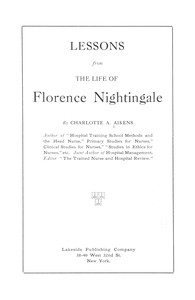
Lessons from the life of Florence Nightingale — Text and Context

(0 User reviews)   1765
In Category - Public Health
Aikens, Charlotte A. (Charlotte Albina), 1868-1949 Project Gutenberg 2024 Not confirmed
Nightingale, Florence, 1820-1910; Nursing; Nurses Readers of public-domain and historical texts
Project Gutenberg digital edition en

Edition facts

Words 15,515
Reading time 68 min
Text sections 8

Before opening Lessons from the life of Florence Nightingale — Text and Context, the edition data offers a quick orientation: 15,515 words, 1 hr 8 min estimated reading time, and 8 detected text sections.

The text analysis averages about 25.4 words per sentence, while the detected sections provide another way to judge how the source is divided.

Project Gutenberg metadata also associates the work with “Nightingale, Florence, 1820-1910,” connecting these edition facts with the source record’s subject description.

Charlotte A. Aikens examines Florence Nightingale's life and writings, focusing on her principles of nursing, hospital reform, and the founding of the Nightingale Training School, using excerpts from Nightingale's own works to illustrate her enduring lessons.
Share
Editorial Edition Score 4.6/5

Calculated from edition completeness, EPUB availability, text structure and catalogue metadata. Not a user rating.

How this score is calculated
  • Description quality20 pts
  • Title & short description10 pts
  • Source metadata20 pts
  • Text length15 pts
  • Chapters / structure15 pts
  • EPUB file integrity20 pts

Total of 100 points, scaled to a 2.5-5.0 range. Editions with an empty description or a missing EPUB file are not scored.

Edition quality

Public-domain source text

Read the source text

The source text is kept in the dedicated reader, separate from this catalogue record and its commentary.

Charlotte A. Aikens opens her study by linking the presence of thousands of trained nurses in World War I to the Crimean War, where Nightingale first demonstrated the need for skilled nursing. Aikens immediately establishes that her book is not a biography but a collection of lessons drawn from Nightingale's career and writings. The opening chapter emphasizes that nursing skill requires special gifts and training, not something to be 'picked up.' Aikens quotes Nightingale's Notes on Nursing extensively, using the author's own words to ground the lessons in primary evidence.

The Call to Service and the Crimean War

Aikens devotes a chapter to Nightingale's response to the Crimean War, where she led a group of nurses to Scutari. The text notes that before Nightingale, women nurses were not wanted by military commanders. Aikens uses this historical moment to highlight Nightingale's perseverance and the systemic resistance she faced. The chapter draws on contemporary accounts to show how Nightingale's work changed public perception, but Aikens does not fabricate specific events beyond what the excerpts provide. The focus remains on the lesson of determination in the face of institutional opposition.

Principles from 'Notes on Nursing'

Aikens quotes extensively from Nightingale's Notes on Nursing, emphasizing her 'gospel of fresh air.' Nightingale insisted that pure air is the first essential for a patient, and that fumigations only mask problems. Aikens selects passages that stress the nurse's duty to ensure cleanliness and ventilation, even against the patient's wishes. The excerpts show Nightingale's direct, sometimes blunt style: 'True nursing ignores infection except to prevent it.' Aikens uses these quotations to illustrate that Nightingale's principles remain relevant, noting that many homes still ignore her advice on fresh air.

The Nightingale Training School and Legacy

The final chapter discusses the founding of the Nightingale Training School for Nurses. Aikens presents this as the institutionalization of Nightingale's methods. The text emphasizes that Nightingale believed nursing required both precept and example, and her school aimed to produce nurses who could apply her principles. Aikens notes that the school's establishment marked a turning point in professional nursing. The excerpts do not provide details of the school's curriculum, but Aikens frames it as a direct outcome of Nightingale's wartime experiences and her writings.

Aikens' Use of Nightingale's Own Words

Aikens relies heavily on direct quotations from Nightingale, particularly from Notes on Nursing. This technique allows Nightingale's voice to dominate the lessons. For example, Nightingale's advice on keeping the air pure and avoiding chill is presented verbatim. Aikens also includes Longfellow's poem 'Santa Filomena' at the start, which depicts Nightingale as 'a lady with a lamp.' This poetic framing contrasts with the practical, no-nonsense tone of the prose excerpts. Aikens does not analyze the poem but lets it stand as a cultural touchstone, leaving readers to consider how myth and reality intersect.

Aikens' book is best read as a companion to Nightingale's own writings, not as a standalone biography. The excerpts suggest that Aikens expects readers to already know the broad outlines of Nightingale's life; she focuses instead on extracting actionable principles. Readers new to Nightingale may benefit from first reading Notes on Nursing to hear her voice directly. Aikens' selection of quotations reveals her admiration for Nightingale's practical wisdom, but she stops short of hagiography, letting the historical record speak.

I have spent many evenings with Miss Nightingale’s words, the quiet discipline of her calling echoing through Aikens’ careful hand. And somehow, the practical wisdom in The Health Master — Edition Insights shares that same unhurried certainty, as if both books knew long ago that true care is simply steadfast attention. They sit well together on my shelf. Lessons from the life of Florence Nightingale — Text and Context whispers, and the other answers softly.

There are no reviews for this eBook.

0
0 out of 5 (0 User reviews )

Add a Review

Your Rating *
There are no comments for this eBook.

Reader reflection

What was your reading experience?

Capture what you thought, learned, and would like to remember.

Your progress 0 / 10
1

How far have you progressed with this book?

2

How much did you enjoy the reading experience?

3

Would you encourage someone else to read it?

4

How demanding did the text feel?

Related eBooks