
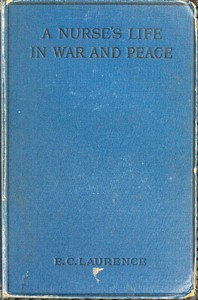
A Nurse's Life in War and Peace — Reading Notes

(0 User reviews)   763
In Category - Public Health
Laurence, E. C. (Eleanor Constance), Treves, Frederick, 1853-1923 [Author of introduction, etc.] Project Gutenberg 2016 Not confirmed
South African War, 1899-1902 -- Medical care; Nursing -- Great Britain; Military nursing Readers of public-domain and historical texts
Project Gutenberg digital edition en

Edition facts

Words 96,820
Reading time 421 min
Text sections 9

Before opening A Nurse's Life in War and Peace — Reading Notes, the edition data offers a quick orientation: 96,820 words, 7 hr 1 min estimated reading time, and 9 detected text sections.

The text analysis averages about 30.2 words per sentence, while the detected sections provide another way to judge how the source is divided.

Project Gutenberg metadata also associates the work with “South African War, 1899-1902 -- Medical care,” connecting these edition facts with the source record’s subject description.

A nurse's firsthand letters detail her training and service in the Boer War, offering a candid, unromanticized view of military nursing, from makeshift hospitals to typhoid wards, with a focus on practical challenges and patient care.
Share
Editorial Edition Score 4.8/5

Calculated from edition completeness, EPUB availability, text structure and catalogue metadata. Not a user rating.

How this score is calculated
  • Description quality20 pts
  • Title & short description10 pts
  • Source metadata20 pts
  • Text length15 pts
  • Chapters / structure15 pts
  • EPUB file integrity20 pts

Total of 100 points, scaled to a 2.5-5.0 range. Editions with an empty description or a missing EPUB file are not scored.

Edition quality

Public-domain source text

Read the source text

The source text is kept in the dedicated reader, separate from this catalogue record and its commentary.

Sir Frederick Treves's preface immediately sets the tone for this collection of letters: he praises their "simplicity, their artlessness, their obvious candour." The reader is warned away from melodramatic sickbed scenes; instead, the book promises a "plain, untinted account" of a nurse's career. The author, E. C. Laurence, was a Royal Red Cross nurse, and her letters trace her path from preliminary training to service in the South African War. The preface frames the work as a corrective to romanticized nursing narratives, emphasizing the practical, unemotional, and matter-of-fact voice that follows.

From Training to the Front

The early letters describe Laurence's initial hospital experiences, including her first "special" case and the challenges of hospital food. The narrative then shifts abruptly to the war zone. In a letter from Deelfontein, she recounts the aftermath of a train accident: fifteen mules dead or shot, three Army Service Corps men injured, and two black mule-drivers with "dreadfully smashed up" arms. Laurence notes that a tent was pitched for these native patients, and she took a "prowl round" at night to check on orderlies. The tone is brisk and administrative, focusing on logistics—building wards, assigning staff, and preparing to receive patients from the front.

Typhoid and the Reality of War Nursing

A letter from Pinetown, Natal, dated May 1900, plunges into the grim reality of nursing typhoid cases. Laurence describes the arrival of fourteen officers and sixteen men, all stretcher cases, many suffering from typhoid. She notes that the journey of over 200 miles in a jolting train was "almost murder" for these men. The orderlies were inexperienced: they could not undress patients, wash them, or handle delirium. Laurence records that four patients were not expected to survive the first night, yet all did—except one who died a week later from exhaustion. She bluntly states the men had not had their clothes off for weeks, and "creeping things are numerous." The focus is on the physical and logistical struggle, not sentiment.

The Nurse's Voice and Daily Routine

Throughout the excerpts, Laurence's voice is direct and unadorned. She describes her own fatigue—"the fleas always wake me up at least once, otherwise I am so tired I don't think I could wake myself"—and the difficulties of maintaining hygiene with scarce water. She notes that many men had not slept in a bed for months, and that a good wash brought "tears of gratitude." Her observations are precise: she distinguishes between the wounded and the sick, notes the stages of typhoid, and records the practical details of setting up a hospital in the field. The letters are addressed to family or friends, but they avoid personal drama, focusing instead on the work at hand.

What the Excerpts Leave Unseen

The provided excerpts cover only the preface and two wartime letters, leaving much of the book's scope unknown. The table of contents suggests earlier chapters on training, a visit to Tenerife, and hospital experiences, but these are not included. The later letters may cover the remainder of the war or peacetime nursing. Readers should not assume the entire book is about war; the title promises "war and peace," and the preface indicates a broader career. The excerpts show a nurse who is practical, observant, and unsentimental, but the full range of her experiences—including peacetime work—remains to be discovered.

These letters reward a reader who values concrete detail over emotional appeal. Laurence's account is best approached as a primary source on military nursing, not a memoir of personal heroism. The preface's warning against "sickly romance" is a reliable guide: expect descriptions of sore backs, lice, and administrative headaches rather than dramatic rescues. For those interested in the practical history of nursing or the Boer War from a medical perspective, this book offers a rare, unvarnished view.

That rainy afternoon, the nurse’s letters kept returning to the stubborn, failing pulse of typhoid patients, how she counted each beat as a small war of its own. Afterwards, restless, I picked up The Works of William Harvey M.D. Translated from the Latin with a life of the author Inside the Classic, and found the same quiet attention—only he was mapping the heart’s machinery, centuries before her hands learned its rhythms.

There are no reviews for this eBook.

0
0 out of 5 (0 User reviews )

Add a Review

Your Rating *
There are no comments for this eBook.

Reader reflection

Your personal reading reflection

Build a private reading journal entry for this title.

Your progress 0 / 10
1

Have you finished this book?

2

Did this book hold your interest?

3

Would you encourage someone else to read it?

4

How demanding did the text feel?

Related eBooks