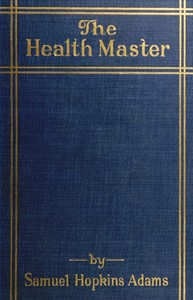
The Health Master — Edition Insights

(0 User reviews)   1451
In Category - Public Health
Adams, Samuel Hopkins, 1871-1958 Project Gutenberg 2018 Not confirmed
Health; Public health Readers of public-domain and historical texts
Project Gutenberg digital edition en

Edition facts

Words 75,964
Reading time 331 min
Text sections 15

For The Health Master — Edition Insights, the stored edition analysis reports 75,964 words, 5 hr 31 min estimated reading time, and 15 detected text sections.

The text analysis averages about 12.6 words per sentence, while the detected sections provide another way to judge how the source is divided.

Project Gutenberg metadata also associates the work with “Health,” connecting these edition facts with the source record’s subject description.

This editorial note examines how Samuel Hopkins Adams's 1913 public health book uses fictional vignettes and a recurring 'Health Master' character to convey preventive medicine principles, focusing on the opening, middle, and later excerpts.
Share
Editorial Edition Score 4.8/5

Calculated from edition completeness, EPUB availability, text structure and catalogue metadata. Not a user rating.

How this score is calculated
  • Description quality20 pts
  • Title & short description10 pts
  • Source metadata20 pts
  • Text length15 pts
  • Chapters / structure15 pts
  • EPUB file integrity20 pts

Total of 100 points, scaled to a 2.5-5.0 range. Editions with an empty description or a missing EPUB file are not scored.

Edition quality

Public-domain source text

Read the source text

The source text is kept in the dedicated reader, separate from this catalogue record and its commentary.

Samuel Hopkins Adams's The Health Master (1913) opens not with a treatise but with a scene: Mr. Thomas Clyde boards a streetcar with 'ease and agility worthy of a younger and less portly man.' This small detail signals the book's method—embedding health advice in everyday life. The introductory note warns that 'to dogmatise on questions of medical practice is to invite controversy,' yet the chapters that follow present a confident 'Chinese plan' physician, Dr. Strong, who treats families rather than diseases. The excerpts show a work that blends fiction, instruction, and advocacy, aiming to 'aid the work' of public health officials.

The Opening: A Fictional Frame for Fact

The first chapter, 'The Chinese Plan Physician,' introduces Dr. Strong through Clyde's perspective. The prose is brisk and observational: Clyde 'swung aboard with an ease and agility worthy of a younger and less portly man.' This is not a dry manual but a narrative with characters, dialogue, and a setting—Monument Square. The Health Master's role is defined by contrast: he is hired 'on the Chinese plan,' meaning he is paid to keep the family well, not just treat illness. The excerpt establishes a tone of practical optimism, with Dr. Strong's 'reassuring smile' and his habit of quoting poetry, as when he cites Swinburne to describe a patient. Readers should note how Adams uses these fictional elements to make medical concepts tangible.

The Middle: Diagnosis and Domestic Drama

In 'The Red Placard,' the seventh chapter, the narrative shifts to a crisis: young Charley Clyde has scarlet fever. The scene is domestic and tense, with Mrs. Clyde 'haggardly' facing Dr. Strong. The diagnosis unfolds through dialogue, not exposition. Grandma Sharpless asserts, 'It's scarlet fever,' based on 'something in the look of the throat and something about the eyes and skin.' Dr. Strong defers to her experience, saying 'experience is the true teacher of diagnosis.' This moment reveals Adams's strategy: he dramatizes medical reasoning through character interaction. The chapter also introduces a key theme—isolation versus exposure—as Dr. Strong argues against sending the other children away, claiming it is not 'certain' they will catch it. The excerpt leaves the debate unresolved, inviting readers to consider the rationale.

The Later Excerpt: A Remade Lady and Poetic Allusion

A later excerpt, likely from 'The Re-Made Lady,' shows Dr. Strong's work extending beyond illness to physical rehabilitation. A character named Miss Ennis is described as a 'flushed and lovely athlete,' and Dr. Strong calls her a 'renewal of Nature.' The artist Oren Taylor, who had previously sketched her as 'November, the withered mourner of glories dead and gone,' now sees her as 'Atalanta'—the 'maiden spirit of the spring.' This transformation is presented as a medical success, but Adams does not explain the specifics. The poetic exchange (quoting Swinburne) suggests that health, in this book, is also an aesthetic and emotional restoration. Readers should observe how Adams uses art and literature to frame health as a holistic ideal.

Structure and Voice: A Hybrid of Instruction and Story

The excerpts reveal a deliberate structure: each chapter appears to be a self-contained vignette, likely drawn from Adams's serialized publications in The Delineator, Collier's Weekly, and The Ladies' Home Journal. The voice shifts between omniscient narrator and dialogue, with Dr. Strong as the consistent authority. The introductory note emphasizes that 'every chapter has been submitted to the expert criticism of specialists,' yet the prose remains accessible, even playful. Adams avoids jargon, preferring phrases like 'thoroughgoing fever' and 'born diagnostician.' The book's 12 chapters cover topics from drugstores to 'The Besieged City,' suggesting a broad survey of public health. Readers should approach each chapter as a case study, noting how Adams balances factual claims with narrative tension.

As you read The Health Master, pay attention to how Adams uses Dr. Strong as a mouthpiece for progressive health ideas while also giving him a personality—he is reassuring, poetic, and occasionally stubborn. The excerpts hint at a recurring pattern: a health problem arises, Dr. Strong intervenes, and a lesson emerges through conversation rather than lecture. The book is best read as a series of linked stories, each illustrating a principle of preventive medicine. Let the fictional scenes guide your understanding of the underlying science.

I keep thinking about how Adams’s Health Master felt almost like a kind friend explaining things I already knew but couldn’t say. That same gentle certainty seems to live in the old London sanitation story—mud, cholera, slow human progress. I remember the quiet ache of closing that book, grateful for things I never had to live through. The Sanitary Evolution of London — Themes and Context brought that feeling back, oddly enough.

There are no reviews for this eBook.

0
0 out of 5 (0 User reviews )

Add a Review

Your Rating *
There are no comments for this eBook.

Reader reflection

Before you leave, reflect on the book

Use these questions to collect your thoughts before moving on.

Your progress 0 / 10
1

Where are you in your reading?

2

What was your overall reaction to the book?

3

Would you encourage someone else to read it?

4

What was the reading difficulty like?

Related eBooks