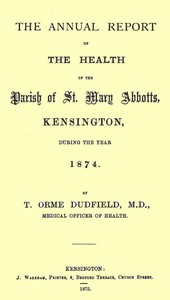
The Annual Report on the Health of the Parish of St. Mary Abbotts, Kensington, during the year 1874 — Context and Discussion

(0 User reviews)   889
In Category - Public Health
Dudfield, T. Orme (Thomas Orme), 1833-1908 Project Gutenberg 2020 Not confirmed
Public health -- England -- London Readers of public-domain and historical texts
Project Gutenberg digital edition en

Edition facts

Words 28,063
Reading time 123 min
Text sections 6

The source record for The Annual Report on the Health of the Parish of St. Mary Abbotts, Kensington, during the year 1874 — Context and Discussion measures this digital text at 28,063 words, 2 hr 3 min estimated reading time, and 6 detected text sections.

The text analysis averages about 13.6 words per sentence, while the detected sections provide another way to judge how the source is divided.

Project Gutenberg metadata also associates the work with “Public health -- England -- London,” connecting these edition facts with the source record’s subject description.

Dudfield's 1874 report on Kensington's health uses mortality tables, milk-borne disease outbreaks, and dust-bin complaints to reveal how a Victorian medical officer balanced statistics with on-the-ground sanitary enforcement.
Share
Editorial Edition Score 4.6/5

Calculated from edition completeness, EPUB availability, text structure and catalogue metadata. Not a user rating.

How this score is calculated
  • Description quality20 pts
  • Title & short description10 pts
  • Source metadata20 pts
  • Text length15 pts
  • Chapters / structure15 pts
  • EPUB file integrity20 pts

Total of 100 points, scaled to a 2.5-5.0 range. Editions with an empty description or a missing EPUB file are not scored.

Edition quality

Public-domain source text

Read the source text

The source text is kept in the dedicated reader, separate from this catalogue record and its commentary.

Dudfield opens his nineteenth annual report by addressing a higher death rate in 1874, immediately distinguishing between metropolitan and local mortality figures. He notes that Kensington's registration district comprises two sub-districts—Town and Brompton—whose vital statistics contrast sharply. This geographic precision, paired with tables of deaths by class and order of disease, sets the tone for a document that treats public health as a matter of local administration as much as medical science.

Milk as a Vector of Disease

Dudfield devotes several pages to outbreaks of scarlet fever and dysentery that he attributes to contaminated milk. He references events earlier in the report (p. 10) where diseased cows were suspected of transmitting illness through their milk. The language is cautious—he writes of outbreaks “supposed to depend on Contamination of Milk” and cases “supposed to be due to the use of the Milk of diseased Cows”—but the implication is clear: the urban milk supply, sourced from cowsheds within the parish, posed a direct threat to public health. This section reveals how a Victorian health officer connected clinical observation to a specific commercial practice, and it foreshadows the detailed scrutiny of cow sheds later in the report.

The Dust-Bin Problem

A striking passage details the administrative burden of dust removal. Dudfield records 5,891 communications, 1,010 complaints, and 10,177 orders issued for dust removal during the year. He describes how contractors failed to fulfill their duties, leading the Vestry to impose penalties and even hire its own horses and carts. The lack of a suitable site for intermediate dust storage, he argues, “rendered nugatory all the labour bestowed on the question.” This is not a dry statistic; it is a portrait of a sanitary system strained by rapid urban growth, where the most mundane service—emptying dust-bins—could consume an “inordinate amount of time” and expose the limits of private contracting.

Cow Sheds Under Scrutiny

Dudfield’s discussion of cow sheds is notable for its regulatory ambition. He calls for legislation requiring public notice before annual licensing, akin to the system for public houses, so that neighbours could object. He describes poorly constructed sheds as “imperfectly ventilated stables” and argues that proper construction—well drained, paved, lighted, and ventilated—was becoming better understood each year. The passage blends technical description with a clear advocacy for tighter supervision, showing how the medical officer used his annual report not merely to record but to push for structural reform.

The Shape of the Report

The table of contents lists over forty topics, from puerperal mortality to sewer ventilation, but the excerpts concentrate on a few interconnected themes: milk, dust, and animal-keeping. Dudfield’s method is cumulative: he returns to the same subjects—cow sheds, slaughter houses, bakehouses—in different sections, building a case for systematic oversight. The statistical appendix (Tables) is promised but not excerpted; the body text itself, however, is rich with numbers—1,010 complaints, 108 bakehouses, 5,891 communications—that ground his arguments in administrative reality. Readers should note how Dudfield moves between specific incidents (a conviction for keeping swine on prohibited premises) and general principles (the need for a disinfecting chamber), always tying local detail to broader sanitary logic.

Dudfield’s report rewards a reader who treats its tables and narratives as complementary evidence. The excerpts suggest that the most revealing passages are not the mortality summaries but the accounts of enforcement—the dust inspector hired, the contractor penalised, the cowshed license debated. A first-time reader might begin with the sections on milk and dust, then trace how Dudfield connects those practical struggles to the vital statistics that open the report.

Dudfield’s ledgers of Kensington’s dust-bins and milk-pans always felt to me like a gentle hand steadying a nervous child. He counted deaths not to alarm, but to soothe. That same calm cadence breathes through Principles of Public Health A Simple Text Book on Hygiene, Presenting the Principles Fundamental to the Conservation of Individual and Community Health — Key Ideas to Explore, a later friend who kept his lantern lit for quieter corridors.

There are no reviews for this eBook.

0
0 out of 5 (0 User reviews )

Add a Review

Your Rating *
There are no comments for this eBook.

Reader reflection

What was your reading experience?

Capture what you thought, learned, and would like to remember.

Your progress 0 / 10
1

Have you finished this book?

2

Did this book hold your interest?

3

Would you pass this book on to a friend?

4

How much effort did this book require?

Related eBooks