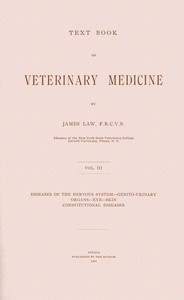
Text book of veterinary medicine, Volume 3 (of 5) — Text and Context

(0 User reviews)   101
In Category - Nursing Hygiene
Law, James, 1838-1921 Project Gutenberg 2023 Not confirmed
Veterinary medicine Readers of public-domain and historical texts
Project Gutenberg digital edition en

Edition facts

Words 220,257
Reading time 958 min
Text sections 288

Text book of veterinary medicine, Volume 3 (of 5) — Text and Context can be approached with a clearer sense of reading commitment from its source measurements: 220,257 words, 15 hr 58 min estimated reading time, and 288 detected text sections.

The text analysis averages about 19.7 words per sentence, while the detected sections provide another way to judge how the source is divided.

Project Gutenberg metadata also associates the work with “Veterinary medicine,” connecting these edition facts with the source record’s subject description.

James Law's 1901 veterinary text examines diseases of the nervous system, genito-urinary organs, eye, and skin, with detailed clinical observations and statistical data. The excerpt on parturient paresis in cows illustrates his method: analyzing causes like high feeding, plethora, and season, while cautioning against oversimplified explanations.
Share
Editorial Edition Score 4.9/5

Calculated from edition completeness, EPUB availability, text structure and catalogue metadata. Not a user rating.

How this score is calculated
  • Description quality20 pts
  • Title & short description10 pts
  • Source metadata20 pts
  • Text length15 pts
  • Chapters / structure15 pts
  • EPUB file integrity20 pts

Total of 100 points, scaled to a 2.5-5.0 range. Editions with an empty description or a missing EPUB file are not scored.

Edition quality

Public-domain source text

Read the source text

The source text is kept in the dedicated reader, separate from this catalogue record and its commentary.

James Law's Text Book of Veterinary Medicine, Volume 3 (1901) opens with a detailed table of contents that immediately signals its systematic approach: diseases are grouped by body system, and within each, specific conditions are listed with clinical precision. The excerpt on parturient paresis in cows exemplifies Law's method—he weighs multiple causal factors, from high feeding and plethora to season and idiosyncrasy, while noting that the disease is "all but unknown in primipara" and rarely follows difficult deliveries. His prose is direct, grounded in observation, and avoids sweeping claims.

Diction of Clinical Causation

Law's language in the parturient paresis section reveals a careful weighing of evidence. He uses phrases like "most prominent cause" and "potent factor" rather than absolute statements. When discussing high feeding, he notes that owners "usually hold to the principle" of near-starvation before calving—a phrasing that reports practice without endorsing it. He also distinguishes between "plethora" and mere fatness: "The predisposing condition is plethora rather than fat or flesh." This lexical choice shows his effort to refine veterinary concepts. Similarly, he dismisses "shock or wearing out of nervous energy" as explanations, arguing that the disease's occurrence after easy deliveries "should to a large extent exclude such alleged factors." His diction consistently prioritizes observable patterns over received wisdom.

Statistical Reasoning in Veterinary Diagnosis

Law incorporates a table from Danish and Bavarian records showing case distribution by age: most cases occur between the 6th and 10th year, with a peak at age 8 (202 cases). He interprets this as reflecting the period of "most vigorous, mature life" and notes that in well-managed dairies, the best cows are kept to these ages. The decline after age 10 he attributes to failing vitality, not immunity. This statistical grounding is typical of Law's approach—he uses numbers to support clinical generalizations, but always with qualification. He also observes that the disease is "all but unknown in primipara," a statement that invites further investigation but does not overreach.

Structure of Causal Analysis

The excerpt on parturient paresis is organized as a series of discrete causal factors, each introduced with a bolded heading: "High Feeding," "Plethora. High Condition," "Parturition," "The Warm Summer Season," "Chills," and "Idiosyncrasy." This structure mirrors the book's overall systematic layout. Within each section, Law presents evidence and counter-evidence. For example, under "The Warm Summer Season," he acknowledges the claim but immediately introduces a confounding variable: "this fails to take into account the still more important element of the rich spring and early summer pastures." This dialectical structure—claim, objection, refinement—is a hallmark of Law's expository style, reflecting a scientific mindset that tests hypotheses against observed reality.

Voice of the Practitioner-Researcher

Law's authorial voice blends the authority of a professor with the practicality of a field veterinarian. He writes from experience: "In herds where this rule is acted on the disease is rare and may be altogether unknown." He also addresses the complexity of individual cases, noting that "a certain number are actually thin" despite the general association with high condition. His discussion of the heavy milker that "remains thin in flesh no matter how heavily she may be fed" shows an understanding of metabolic variation. The tone is instructive but not dogmatic; he presents principles while acknowledging exceptions. This balance between generalization and nuance gives the text enduring value for veterinary readers.

Readers approaching this volume should note that Law's method—combining clinical observation, statistical data, and causal reasoning—requires careful attention to his qualifying language. He often presents multiple factors without assigning fixed weights, leaving room for the practitioner's judgment. The book is best used as a reference for specific conditions, but the excerpt on parturient paresis also rewards a close reading of how Law constructs his arguments. His voice is that of a teacher who expects his students to think critically about cause and effect.

I remember old Dr. Law fretting over his cows, how a full stomach could dull a good mind. There is a certain tenderness in his worry, a physician’s patience for the body’s stubborn ways. It reminds me of that fellow who wrote How to Collect a Doctor Bill — Themes and Context, pondering the ledger’s own quiet reckoning with care.

There are no reviews for this eBook.

0
0 out of 5 (0 User reviews )

Add a Review

Your Rating *
There are no comments for this eBook.

Reader reflection

Take a moment to reflect on this book

Create a short personal record of your experience with this book.

Your progress 0 / 10
1

How far have you progressed with this book?

2

Did this book hold your interest?

3

Is this a title you would suggest to others?

4

What was the reading difficulty like?

Related eBooks