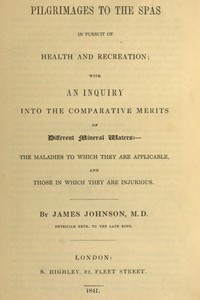
Pilgrimages to the Spas in Pursuit of Health and Recreation With an inquiry into the comparative merits of different mineral waters: the maladies to which they are — A Closer Reading

(0 User reviews)   416
In Category - Nursing Hygiene
Johnson, James, 1777-1845 Project Gutenberg 2019 Not confirmed
Health resorts; Mineral waters; Balneology Readers of public-domain and historical texts
Project Gutenberg digital edition en

Edition facts

Words 153,793
Reading time 669 min
Text sections 18

The catalog record for Pilgrimages to the Spas in Pursuit of Health and Recreation With an inquiry into the comparative merits of different mineral waters: the maladies to which they are — A Closer Reading provides practical reading context through 153,793 words, 11 hr 9 min estimated reading time, and 18 detected text sections.

The text analysis averages about 23.9 words per sentence, while the detected sections provide another way to judge how the source is divided.

Project Gutenberg metadata also associates the work with “Health resorts,” connecting these edition facts with the source record’s subject description.

James Johnson's 1841 medical travelogue blends spa evaluations with Rhine legends, mixing clinical warnings about mineral waters with sharp social observations. The author's voice shifts from physician to moralist, using varied pacing to contrast therapeutic advice with scenic description.
Share
Editorial Edition Score 4.8/5

Calculated from edition completeness, EPUB availability, text structure and catalogue metadata. Not a user rating.

How this score is calculated
  • Description quality20 pts
  • Title & short description10 pts
  • Source metadata20 pts
  • Text length15 pts
  • Chapters / structure15 pts
  • EPUB file integrity20 pts

Total of 100 points, scaled to a 2.5-5.0 range. Editions with an empty description or a missing EPUB file are not scored.

Edition quality

Public-domain source text

Read the source text

The source text is kept in the dedicated reader, separate from this catalogue record and its commentary.

James Johnson, M.D., opens his 1841 work by declaring that his observations are the results of several autumnal excursions, undertaken partly for health, partly for recreation, and partly for information. This triple motive shapes the book's hybrid character: it is at once a medical treatise, a travelogue, and a collection of moralized legends. Johnson defends his right to stray from professional topics, asserting that a physician's education and knowledge of human nature qualify him for general observations. The preface sets a tone of independence, with Johnson stating he has followed his own inclinations and offers no other reason than the old one—'stat pro ratione voluntas.'

A Physician's Dual Voice

Throughout the excerpts, Johnson alternates between clinical precision and a more discursive, almost literary register. In his warnings about spa treatments, he lists symptoms with methodical care: 'giddiness, sleepiness, chilliness, confusion of thought, weariness, head-ache, pains in the limbs, unusual sounds in the ears, sparks before the eyes.' The catalogue reads like a diagnostic checklist. Yet when describing Frankfort, his prose becomes playful and satirical: 'It is a free-fort, that is, it is free from fort or citadel—rampart or fosse—glacis or sallyport—cannon or mortar—shot or shells!' The repetition and rhythmic listing reveal a writer enjoying language. This shift in voice—from the cautious physician to the observant traveler—creates a layered narrative where medical authority coexists with personal commentary.

Pacing Through Contrasts

Johnson controls the pace of his narrative by juxtaposing dense medical passages with lighter, anecdotal sections. The warning about spa dangers builds tension through a long list of adverse symptoms, culminating in an urgent 'Beware! you are standing on a precipice!' The rhythm quickens. Then, abruptly, he shifts to a casual departure from Ems: 'We must now take leave of Ems. It is a very hot place in warm weather.' The change in tempo is deliberate. Similarly, his description of Frankfort's cemetery moves from a brisk, ironic tone—'a huge painted sepulchre'—to a slower, more reflective meditation on the dead who 'sleep without dreams.' These contrasts in pacing keep the reader engaged, preventing the medical advice from becoming monotonous.

Recurring Patterns in Description

Johnson frequently employs parallel structures and lists to organize his observations. In the Frankfort passage, he strings together pairs: 'commerce and carriages—of Jews and of Gentiles—of bankers and of brokers—of lenders and of venders.' This rhetorical device gives a sense of abundance and variety. He also uses contrast as a structural principle: the old and new parts of Frankfort present 'youth and beauty united to age and ugliness.' The cemetery is described as a 'city of the dead' set against the 'busy city on the banks of the Main.' These recurring patterns—lists, antitheses, and parallel constructions—give the prose a formal, almost architectural quality, reflecting Johnson's methodical mind even when he is not writing about medicine.

Readers should approach Pilgrimages to the Spas as a work that resists easy classification. Johnson's voice is that of a physician who refuses to be confined to professional topics, and his book rewards attention to its shifts in tone and pace. The medical advice is specific and cautionary, but the travel observations are equally detailed. Pay attention to how Johnson uses lists and contrasts to structure his descriptions; these rhetorical choices reveal as much about his method as his diagnoses do about the spas.

Dr. Johnson’s spa pilgrimages taught me how earnest healing can be, yet there’s a dear cousin to that solemnity—the knowing wink in The Funny Side of Physic Or, The Mysteries of Medicine, Presenting the Humorous and Serious Sides of Medical Practice. An Exposé of Medical Humbugs, Quacks, and Charlatans — A Closer Reading. They sit side by side on my shelf, sharing one quiet laugh about our frail, hopeful bodies.

There are no reviews for this eBook.

0
0 out of 5 (0 User reviews )

Add a Review

Your Rating *
There are no comments for this eBook.

Reader reflection

Take a moment to reflect on this book

Create a short personal record of your experience with this book.

Your progress 0 / 10
1

Have you finished this book?

2

What was your overall reaction to the book?

3

How likely are you to recommend this book?

4

Did the language feel accessible?

Related eBooks