
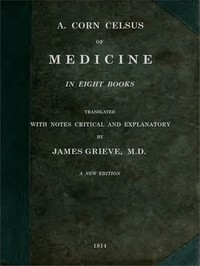
Of Medicine, in Eight Books — Inside the Classic

(0 User reviews)   244
In Category - Nursing Hygiene
Celsus, Aulus Cornelius, 26? BCE-50?, Greive, James, -1773 [Translator] Project Gutenberg 2021 Not confirmed
Medicine, Greek and Roman Readers of public-domain and historical texts
Project Gutenberg digital edition en

Edition facts

Words 197,317
Reading time 858 min
Text sections 218

Before opening Of Medicine, in Eight Books — Inside the Classic, the edition data offers a quick orientation: 197,317 words, 14 hr 18 min estimated reading time, and 218 detected text sections.

The text analysis averages about 24.4 words per sentence, while the detected sections provide another way to judge how the source is divided.

Project Gutenberg metadata also associates the work with “Medicine, Greek and Roman,” connecting these edition facts with the source record’s subject description.

Celsus's encyclopedic medical text, structured in eight books, moves systematically from dietetics to surgery, using precise classification of tumours and treatments. Greive's 1756 translation preserves the original's concise elegance, with extensive footnotes and endnotes linking Greek terms.
Share
Editorial Edition Score 4.9/5

Calculated from edition completeness, EPUB availability, text structure and catalogue metadata. Not a user rating.

How this score is calculated
  • Description quality20 pts
  • Title & short description10 pts
  • Source metadata20 pts
  • Text length15 pts
  • Chapters / structure15 pts
  • EPUB file integrity20 pts

Total of 100 points, scaled to a 2.5-5.0 range. Editions with an empty description or a missing EPUB file are not scored.

Edition quality

Public-domain source text

Read the source text

The source text is kept in the dedicated reader, separate from this catalogue record and its commentary.

Celsus's Of Medicine, in Eight Books opens not with a patient or a remedy but with a question: whether ancient physicians' writings can guide current practice. The translator, James Greive, frames the work as a record of the human body's unchanging mechanism, a premise that underpins the entire eight-book structure. The text moves from regimen and diet in the early books to surgery and pharmacology later, each book accompanied by its own set of numbered explanatory notes. Greive's 1756 translation, revised for this 1814 edition, aims to capture what he calls Celsus's 'conciseness and elegance,' a quality evident in the terse descriptions of tumours and treatments that follow.

A Taxonomy of Swellings

The excerpts reveal a meticulous classification of skin and subcutaneous growths. Celsus distinguishes a furuncle, an 'acute tubercle' that seldom exceeds half an egg in size, from a phyma, which is 'rounder, and flatter' and often larger. A phygethlon is a 'low, but broad tumour' with violent pain disproportionate to its size. The scrophula, described as a tumour with concretions 'resembling small glands,' is noted for its tendency to recur near cicatrices. Each entry follows a consistent pattern: definition, symptoms, prognosis, and remedies. This taxonomic impulse—naming, comparing, and contrasting—gives the text a diagnostic clarity that a modern reader might associate with a botanical or zoological treatise.

Remedies Rooted in Observation

Celsus's therapeutic recommendations are grounded in sensory detail. For a non-ulcerated condition, he prescribes copper 'as hot as a person is able to bear it.' For ulcerated cases, he specifies allum powdered with frankincense and wine, or pomegranate bark boiled in water. The instructions are precise: foment with a hot decoction of turnips, or if unavailable, 'some of the repellent vervains.' The text also records folk knowledge: 'the experience of some peasants has discovered, that eating a snake cures a scrophulous patient.' This juxtaposition of learned medicine and empirical practice recurs throughout, suggesting a work that values efficacy over orthodoxy.

The Surgeon's Caution

Surgical intervention is approached with evident wariness. In discussing scrophula, Celsus notes that whether cured 'by incision or medicines, for the most part they rise again close to the cicatrices.' He adds that recurrence is more likely after treatment with medicines. The furuncle, by contrast, is deemed safe even if left untreated, as it 'maturates of itself, and breaks.' The text's tone is pragmatic: pain makes a hastening medicine 'eligible,' but not essential. This measured assessment of risk and benefit, typical of the surgical books, reflects a physician who weighs intervention against nature's own course.

The Translator's Apparatus

Greive's edition is as much a scholarly tool as a translation. The text is accompanied by eight sets of numbered explanatory notes, hundreds of footnotes (many giving Greek spellings), and hyperlinks to endnotes and index items. The transcriber's notes warn of archaic characters and inconsistent punctuation, preserved from the original. This layered apparatus—translator's preface, author's notes, footnotes, endnotes—creates a palimpsest of voices: Celsus, Greive, and later editors. Readers navigating the work must move between the main text and its scholarly scaffolding, a structure that mirrors the layered nature of medical knowledge itself.

Readers approaching this edition should expect to move slowly, consulting the notes as they go. The work rewards attention to its classificatory logic and to the small details—a peasant's remedy, a surgeon's caution—that reveal the texture of ancient practice. Greive's translation, with its deliberate archaisms, preserves the distance between Celsus's world and ours, while the apparatus bridges that gap. Treat the eight books not as a continuous narrative but as a reference system, best sampled by topic.

Holding Celsus's tidy classifications, I remembered my grandfather's worn copy of Searchlights on Health, its earnest chapters on hygiene and conduct tucked beside his Bible. Both books speak to bodies and their frailties with such quiet authority—one ancient, one Victorian—yet each assumes a reader seeking order in chaos, a comfort I felt again, unexpectedly, in their shared, persistent hope: Searchlights on Health: Light on Dark Corners A Complete Sexual Science and a Guide to Purity and Physical Manhood, Advice To Maiden, Wife, And Mother, Love — Context and Discussion.

There are no reviews for this eBook.

0
0 out of 5 (0 User reviews )

Add a Review

Your Rating *
There are no comments for this eBook.

Reader reflection

Before you leave, reflect on the book

Use these questions to collect your thoughts before moving on.

Your progress 0 / 10
1

Where are you in your reading?

2

How did the book work for you overall?

3

Would you pass this book on to a friend?

4

How much effort did this book require?

Related eBooks