
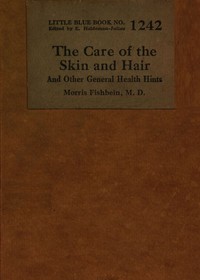
The care of the skin and hair — A Closer Reading

(0 User reviews)   2586
In Category - Medicine
Fishbein, Morris, 1889-1976 Project Gutenberg 2025 Not confirmed
Skin -- Care and hygiene; Hair -- Care and hygiene Readers of public-domain and historical texts
Project Gutenberg digital edition en

Edition facts

Words 9,894
Reading time 44 min
Text sections 22

For The care of the skin and hair — A Closer Reading, the stored edition analysis reports 9,894 words, 44 min estimated reading time, and 22 detected text sections.

The text analysis averages about 25.0 words per sentence, while the detected sections provide another way to judge how the source is divided.

Project Gutenberg metadata also associates the work with “Skin -- Care and hygiene,” connecting these edition facts with the source record’s subject description.

Morris Fishbein's 1927 guide to skin and hair care, from the Little Blue Book series, combines medical authority with practical advice on conditions like psoriasis, boils, and the dangers of cosmetics and quackery.
Share
Editorial Edition Score 4.7/5

Calculated from edition completeness, EPUB availability, text structure and catalogue metadata. Not a user rating.

How this score is calculated
  • Description quality20 pts
  • Title & short description10 pts
  • Source metadata20 pts
  • Text length15 pts
  • Chapters / structure15 pts
  • EPUB file integrity20 pts

Total of 100 points, scaled to a 2.5-5.0 range. Editions with an empty description or a missing EPUB file are not scored.

Edition quality

Public-domain source text

Read the source text

The source text is kept in the dedicated reader, separate from this catalogue record and its commentary.

Morris Fishbein, editor of the Journal of the American Medical Association and Hygeia, opens this Little Blue Book No. 1242 by challenging the belief that skin diseases can be cured with a simple salve or lotion. He immediately establishes a scientific tone, noting that modern treatment draws on physics, chemistry, biology, and bacteriology. The skin, he insists, is not merely a protective covering but an organ whose condition reflects and influences the rest of the body.

Fishbein’s brisk, authoritative voice—shaped by his role as a medical editor—frames each short chapter as a public-health lesson. The table of contents lists twenty-two topics, from plastic surgery to frostbite, each promising concise, evidence-based guidance. Readers should expect a no-nonsense approach that prioritizes hygiene, professional medical care, and skepticism toward nostrums.

From Salves to X-Rays: The Opening Argument

Fishbein’s opening chapter, “Skin Diseases and Their Cure,” wastes no time dismissing folk remedies. He writes that the belief in salves and lotions “is a reflection of the actual knowledge of such conditions held even by the medical profession a quarter of a century ago.” This historical framing is characteristic: he contrasts past ignorance with modern advances, specifically the X-ray, radium, ultraviolet light, and carbon dioxide snow. The physician, he notes, can now attack growths with “any of the destructive rays” or freeze them, cut them, or dry them with electric current.

The chapter also introduces a recurring structural pattern: Fishbein names a specific authority—here, Dr. Fred Wise—to anchor his claims. He does not merely list treatments but explains why they work, grounding each in a principle of physics or biology. For a first-time reader, this opening establishes that the book will be less a home-remedy manual and more a primer on the scientific rationale behind dermatology.

Boils, Resistance, and the Body’s Defenses

In the chapter on boils, Fishbein shifts from general principles to a specific condition, demonstrating his method. He identifies the neck as the most common site, “usually because of the constant rubbing of the collar on the hair.” This observation is typical: he links a medical fact to everyday behavior. He then warns that recurring boils may signal diabetes, urging a doctor’s visit—a pattern of connecting skin symptoms to systemic health.

Fishbein’s advice is practical and cautionary. He advises against amateur surgery: “A boil should not be opened by some friend who happens to think himself a surgeon merely because he does not faint at the sight of blood.” The tone is dry, even wry, but the message is serious. He explains that the body’s resistance depends on “substances that will overcome bacteria” and recommends proper diet, cleaning, and attention to infections in the ear, nose, and throat. The chapter ends with a note on vaccines made from the patient’s own bacteria, showing Fishbein’s openness to emerging treatments.

Psoriasis: The Chronic Challenge

Fishbein calls psoriasis “one of the most annoying” skin faults, a phrase that captures his blend of clinical detachment and patient empathy. He describes the disease’s appearance—round, red patches covered with dry, white scales—and its typical locations: the back of the arms, front of the legs, scalp, and lower back, but seldom the face. The condition, he notes, “continues for months and years, sometimes better, sometimes worse,” and while it seldom disturbs general health, its appearance and scaling cause distress.

Here, Fishbein’s editorial voice is most evident. He acknowledges that “the fact that so many methods have been suggested is an indication that none has proved especially satisfactory.” He recommends a specialist and warns against “fads and quackery,” noting that patients often “travel from one specialist to another” and waste funds. This chapter exemplifies the book’s dual purpose: to inform and to inoculate readers against false promises.

Cosmetics, Quackery, and the Reader’s Role

Throughout the excerpts, Fishbein returns to the theme of quackery. The table of contents includes “Skin Disease Quackery” and “Beware of Beauty Doctor Who Offers Guarantees.” In the psoriasis chapter, he explicitly warns against “all sorts of fads and quackery.” This skeptical thread is a key part of the book’s identity: it is not just a guide but a consumer-protection manual.

Fishbein also addresses cosmetics and hair dyes, warning that “either hair or health [is] endangered by dyes.” He links skin eruptions to poison in dyed fur. These warnings are specific and evidence-based, reflecting his role as a medical editor. For a first-time reader, these sections offer a glimpse into 1920s health concerns—and into Fishbein’s campaign against unregulated beauty products. The book’s structure, with short chapters and clear headings, makes it easy to dip into specific topics, but reading sequentially reveals a consistent argument: trust science, not salesmanship.

Fishbein’s Little Blue Book is best approached as a series of short, self-contained lectures rather than a comprehensive textbook. Readers interested in a particular condition—boils, psoriasis, frostbite—can turn directly to that chapter. But the book rewards sequential reading, as Fishbein’s recurring warnings against quackery and his insistence on professional care build a coherent philosophy. The excerpts suggest a work that is both of its time (with references to radium and X-rays as cutting-edge) and enduring in its emphasis on hygiene and skepticism. For modern readers, it offers a window into early twentieth-century medical popularization.

That old Little Blue Book on skin and hair stayed with me—not for the advice itself, but for how gently it trusted its reader to think. It felt like someone quietly saying, you can handle this. That same patient, unhurried trust surfaced again in The seven books of Paulus Ægineta, volume 3 (of 3) — Background and Themes, where ancient care for the body reads less like history and more like a friend’s steady hand, still warm.

There are no reviews for this eBook.

0
0 out of 5 (0 User reviews )

Add a Review

Your Rating *
There are no comments for this eBook.

Reader reflection

Take a moment to reflect on this book

Create a short personal record of your experience with this book.

Your progress 0 / 10
1

Where are you in your reading?

2

Did this book hold your interest?

3

Is this a title you would suggest to others?

4

Did the language feel accessible?

Related eBooks