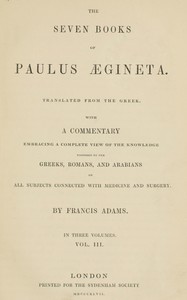
The seven books of Paulus Ægineta, volume 3 (of 3) — Background and Themes

(0 User reviews)   279
In Category - Medicine
Paulus, Aegineta, 625?-690?, Adams, Francis, 1796-1861 [Translator] Project Gutenberg 2023 Not confirmed
Medicine; Medicine, Greek and Roman; Medicine, Arab Readers of public-domain and historical texts
Project Gutenberg digital edition en

Edition facts

Words 244,099
Reading time 1062 min
Text sections 27

The catalog record for The seven books of Paulus Ægineta, volume 3 (of 3) — Background and Themes provides practical reading context through 244,099 words, 17 hr 42 min estimated reading time, and 27 detected text sections.

The text analysis averages about 14.6 words per sentence, while the detected sections provide another way to judge how the source is divided.

Project Gutenberg metadata also associates the work with “Medicine,” connecting these edition facts with the source record’s subject description.

Francis Adams's translation of Paulus Aegineta's seventh-century medical encyclopedia, Volume III focuses on ancient materia medica and pharmacy. The commentary traces Greek, Roman, and Arabic sources, often noting unresolved identifications of plants and drugs.
Share
Editorial Edition Score 4.9/5

Calculated from edition completeness, EPUB availability, text structure and catalogue metadata. Not a user rating.

How this score is calculated
  • Description quality20 pts
  • Title & short description10 pts
  • Source metadata20 pts
  • Text length15 pts
  • Chapters / structure15 pts
  • EPUB file integrity20 pts

Total of 100 points, scaled to a 2.5-5.0 range. Editions with an empty description or a missing EPUB file are not scored.

Edition quality

Public-domain source text

Read the source text

The source text is kept in the dedicated reader, separate from this catalogue record and its commentary.

This third volume of Francis Adams's translation of Paulus Aegineta centers on the Materia Medica and pharmacy of the ancients, a shift from the surgical and pathological focus of the earlier volumes. Adams explains in his advertisement that the commentary here deviates from the plan of the preceding volumes: instead of restricting annotations to ancient literature, he brings them down to modern times, aiming to make the ancient nomenclature accessible for practical use. The excerpts show a meticulous method: for each substance, Paulus's original text is given, followed by a commentary that collates Dioscorides, Galen, and a wide range of Arabic authorities such as Avicenna, Serapion, and Rhases. Adams frequently ends entries with cautious judgments, as when he ranks a plant among 'the undetermined articles in the ancient Materia Medica' after weighing conflicting identifications.

A Commentary That Crosses Centuries and Languages

Adams's commentary is the real engine of this volume. For each entry, he assembles a chain of authorities spanning Greek, Roman, and Arabic medicine. The entry on scammony, for example, cites Nicander, Alexander, Marcellus Empiricus, Celsus, and the Hippocratic collection, then moves to Serapion, Avicenna, Rhases, Haly Abbas, Mesne, Averrhoes, and Ebn Baithar. This is not mere citation: Adams notes disagreements, such as Haly Abbas stating that scammony 'purges bile, attracts humours from the distant parts of the body, but is injurious to the stomach and liver,' while Avicenna and Serapion agree it 'hurts the stomach, liver, and heart.' The commentary thus becomes a layered record of how a single substance was understood across different medical traditions.

Uncertainty as a Scholarly Virtue

Adams does not pretend to resolve every ancient plant name. In the entry on Sisarum, he notes that 'recent authorities hold that it is not the same as the Sium Sisarum, Skerret, as has been generally held, but the Parsnip,' yet he adds that this would make it identical with Dioscorides's elaphoboskos, a conclusion he is 'scarcely prepared to join Sprengel in admitting.' He then ranks the article among 'the undetermined.' This willingness to leave questions open is a consistent feature: the commentary often ends with a phrase like 'it is not clear that they apply these terms to the same substances as Dioscorides does.' The reader is thus invited into a process of scholarly deliberation rather than presented with a closed system.

The Practical Orientation of the Annotation

Adams states his aim explicitly: to render the information 'of ready access for practical purposes.' This practical bent shows in the details he includes. For scammony, he records that 'the dose of it is from 6 to 20 grs.' and that in large doses it 'brings off bilious and bloody discharges, but in small doses, it is said to be diuretic without acting upon the bowels at all.' For sisymbrium, he notes its classification as a calefacient and discutient, and lists specific uses: 'useful in strangury, calculus, tormina, and singultus,' and as a cataplasm for headache and stings. These details ground the ancient text in observable effects, making the volume a reference work for anyone studying historical pharmacy.

Readers approaching this volume should be prepared for a dense, scholarly apparatus that prioritizes evidence over narrative. The commentary assumes familiarity with Greek, Latin, and Arabic medical writers, but Adams's careful cross-referencing and his habit of noting when a plant remains unidentified make the work accessible to those willing to follow the threads. The index, as the transcriber notes, contains links across all three volumes, so digital readers may need to navigate carefully. This is not a book to be read straight through, but one to be consulted entry by entry.

Flipping through the third volume of Paulus Ægineta, I paused again at a plant he could only describe by its effect, the name lost. For a moment, it felt like meeting a woman from history whose life is told through mention, not detail. I thought of Medical Women: Two Essays — Inside the Classic that night, where a similar shadow falls gently. Decades of knowledge, so often mute about its makers.

There are no reviews for this eBook.

0
0 out of 5 (0 User reviews )

Add a Review

Your Rating *
There are no comments for this eBook.

Reader reflection

What was your reading experience?

Capture what you thought, learned, and would like to remember.

Your progress 0 / 10
1

Which reading stage best describes you?

2

How much did you enjoy the reading experience?

3

Would you encourage someone else to read it?

4

Did the language feel accessible?

Related eBooks