
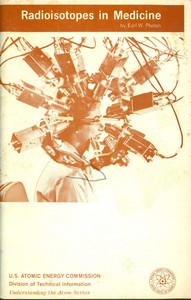
Radioisotopes in Medicine — Text and Context

(0 User reviews)   93
In Category - Anatomy Physiology
Phelan, Earl W., 1900-1993 Project Gutenberg 2015 Not confirmed
Nuclear medicine Readers of public-domain and historical texts
Project Gutenberg digital edition en

Edition facts

Words 16,105
Reading time 71 min
Text sections 3

Radioisotopes in Medicine — Text and Context can be approached with a clearer sense of reading commitment from its source measurements: 16,105 words, 1 hr 11 min estimated reading time, and 3 detected text sections.

The text analysis averages about 19.9 words per sentence, while the detected sections provide another way to judge how the source is divided.

Project Gutenberg metadata also associates the work with “Nuclear medicine,” connecting these edition facts with the source record’s subject description.

An editorial note on Earl W. Phelan's 1966 booklet from the Understanding the Atom Series, examining its clinical case studies, technical explanations, and shifts between narrative and instructional prose in explaining radioisotope use in medicine.
Share
Editorial Edition Score 4.5/5

Calculated from edition completeness, EPUB availability, text structure and catalogue metadata. Not a user rating.

How this score is calculated
  • Description quality20 pts
  • Title & short description10 pts
  • Source metadata20 pts
  • Text length15 pts
  • Chapters / structure15 pts
  • EPUB file integrity20 pts

Total of 100 points, scaled to a 2.5-5.0 range. Editions with an empty description or a missing EPUB file are not scored.

Edition quality

Public-domain source text

Read the source text

The source text is kept in the dedicated reader, separate from this catalogue record and its commentary.

Earl W. Phelan's Radioisotopes in Medicine opens with a dramatic clinical case: a 75-year-old man with laryngeal cancer treated by a cobalt-60 device over 31 days. The narrative voice shifts abruptly from this patient story—complete with quoted daily treatment details and a six-year follow-up—to a general discussion of therapeutic principles. This alternation between anecdotal evidence and systematic exposition characterizes the booklet's approach, reflecting its dual purpose as both public education and technical primer.

Narrative Framing and Clinical Evidence

The booklet's introduction of therapy through a specific patient case is a deliberate rhetorical choice. Phelan writes that “this dramatic tale with a happy ending is a good one with which to start a discussion,” signaling a pedagogical strategy that grounds abstract science in human experience. The case is presented in a block quotation, giving it an almost testimonial quality, before the author resumes his own explanatory voice. This technique recurs throughout: diagnostic sections often begin with a disease or isotope, then pivot to a brief illustrative example. The effect is a rhythm of concrete detail followed by general principle, making the material accessible without sacrificing precision.

Technical Language and Explanatory Pacing

Phelan's prose moves between straightforward definitions and more complex technical passages. For instance, he defines half-life in the context of iodine-131 and iodine-132, noting that “the same weight of radioactive ¹³²I will give a greater radiation dose than ¹³¹I would.” Such comparisons serve as explanatory anchors. However, the text occasionally assumes prior knowledge: terms like “collimator” and “protein-bound iodine” are introduced without immediate gloss. The pace quickens in sections like “Boron-10,” where the description of glioblastoma multiforme—its “roots into normal tissues” and “probable life expectancy of only 1 year”—is starkly clinical, then slows to explain the blood-brain barrier. These shifts in density mirror the booklet's intended audience: curious lay readers willing to engage with some specialized vocabulary.

Structural Repetition and Thematic Coherence

The booklet's organization follows a consistent pattern: each isotope or technique is introduced with a brief history or principle, followed by its medical application. For example, the entry on chromium-51 appears under “Diagnosis” with a short description of its use in labeling red blood cells. This modular structure allows readers to dip into specific sections, but it also creates repetition—the same isotopes (iodine-131, phosphorus-32) reappear in both diagnostic and therapeutic chapters. The cross-referencing is minimal; instead, each section stands alone. This redundancy may reflect the booklet's origin as part of a series designed for piecemeal reading. The appendix and suggested references further reinforce its role as a reference tool rather than a narrative monograph.

Readers will find that the booklet's value lies less in its currency—the science has advanced considerably since 1966—than in its demonstration of mid-century public communication about nuclear medicine. Pay attention to how Phelan balances authority with approachability, and note the tension between the optimistic tone of the introduction and the sobering realities of diseases like glioblastoma. The excerpts offer a window into a specific historical moment in medical education.

That rainy afternoon, I kept returning to Phelan’s quiet case notes, his careful balance of hope and caution. It made me wonder how earlier physicians navigated uncertainty without such tools. Later, almost without thinking, I reached for The growth of medicine from the earliest times to about 1800 — Themes and Context, and felt the same patient curiosity, echoing across centuries.

There are no reviews for this eBook.

0
0 out of 5 (0 User reviews )

Add a Review

Your Rating *
There are no comments for this eBook.

Reader reflection

What did you think of this book?

Answer a few questions and save a private reflection on this device.

Your progress 0 / 10
1

Where are you in your reading?

2

How much did you enjoy the reading experience?

3

Would you pass this book on to a friend?

4

What was the reading difficulty like?

Related eBooks