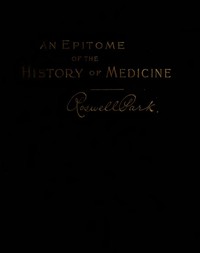
An Epitome of the History of Medicine — Inside the Classic

(0 User reviews)   1331
In Category - Anatomy Physiology
Park, Roswell, 1852-1914 Project Gutenberg 2014 Not confirmed
Medicine -- History Readers of public-domain and historical texts
Project Gutenberg digital edition en

Edition facts

Words 103,192
Reading time 449 min
Text sections 15

The catalog record for An Epitome of the History of Medicine — Inside the Classic provides practical reading context through 103,192 words, 7 hr 29 min estimated reading time, and 15 detected text sections.

The text analysis averages about 26.8 words per sentence, while the detected sections provide another way to judge how the source is divided.

Project Gutenberg metadata also associates the work with “Medicine -- History,” connecting these edition facts with the source record’s subject description.

Roswell Park's 1897 'Epitome' traces medical history as a record of human error and discovery, emphasizing the interplay between medicine, philosophy, theology, and science. Based on his University of Buffalo lectures, the work examines how institutional and intellectual forces shaped—and often hindered—medical progress.
Share
Editorial Edition Score 4.9/5

Calculated from edition completeness, EPUB availability, text structure and catalogue metadata. Not a user rating.

How this score is calculated
  • Description quality20 pts
  • Title & short description10 pts
  • Source metadata20 pts
  • Text length15 pts
  • Chapters / structure15 pts
  • EPUB file integrity20 pts

Total of 100 points, scaled to a 2.5-5.0 range. Editions with an empty description or a missing EPUB file are not scored.

Edition quality

Public-domain source text

Read the source text

The source text is kept in the dedicated reader, separate from this catalogue record and its commentary.

Roswell Park opens his 1897 Epitome of the History of Medicine with a striking claim: the history of medicine is “really a history of human error and of human discovery.” This framing sets the tone for a work that treats medical progress not as a steady march but as a series of missteps, corrections, and recurring patterns. Park, a professor of surgery at the University of Buffalo, originally delivered these lectures to medical students, aiming to fill what he saw as a glaring gap in the curriculum. His preface explicitly links medicine to philosophy, theology, natural science, and even belles-lettres, arguing that the history of the art is inseparable from broader intellectual currents.

Error as a Teacher

Park’s preface insists that the “valuable and fruitful lessons” of medical history lie in “what not to do,” yet he notes that these lessons have been “completely disregarded,” leading to repeated errors. This perspective shapes his treatment of past theories. For instance, he describes the iatrochemical school’s reliance on fermentation and acidity as “inaccurate deductions from experimental observations,” and notes that its therapeutics were so harmful that critics alleged the system “caused as many human lives as the whole thirty years’ war.” Park does not simply catalog such failures; he uses them to illustrate how speculative systems, however popular, can obstruct progress. His emphasis on error as a structural feature of medical history—rather than a series of isolated mistakes—gives the book a distinctive analytical edge.

The Church, Theology, and Medical Stagnation

Park identifies the “frowning or forbidding attitude of the Church” as a major impediment to medical development, though he cautions that this is not a quarrel with the Church of today. He references President White’s History of the Warfare of Science with Theology to support his claims. Throughout the excerpts, this tension appears in the biographies of physicians who were originally destined for theology—like Van Helmont and Thomas Willis—before turning to medicine. Park’s narrative suggests that the separation of medicine from theological control was a slow and contested process, and that institutional resistance often forced practitioners to defend their work against doctrinal objections. This thread gives the book a coherent argument about the social and intellectual conditions that shaped medical knowledge.

Schools, Systems, and the Search for Mechanism

The excerpts reveal Park’s fascination with the competing schools that dominated early modern medicine: iatrochemical, iatromechanical, animist, and vitalist. He describes the iatromechanical school’s attempt to explain digestion as “mechanical trituration” and disease as the presence of “pointed and angular crystals” in the blood. Figures like Santoro (Sanctorius) invented instruments to study the pulse, while Borelli applied mathematical methods to physiology. Park’s treatment is critical but not dismissive; he notes that these systems, however flawed, represented efforts to ground medicine in observable phenomena. The recurring pattern is one of overreach—theories built on partial evidence that later proved inadequate. Park’s own stance emerges implicitly: he values empirical observation and skepticism toward grand systems, a position that aligns with the late-nineteenth-century scientific medicine he practiced.

Park’s Epitome is best read as a series of case studies in how medical knowledge is shaped by its intellectual environment. Readers will find that the book’s value lies not in its completeness—it is, after all, an epitome—but in its willingness to confront the failures and dead ends that punctuate the history of the art. Park’s voice, at once clinical and engaged, makes this a useful companion for anyone interested in how medicine has grappled with its own past.

Holding Roswell Park’s Epitome, I kept thinking how gently he admitted that medicine’s past is mostly missteps we’ve outgrown. That same quiet honesty surfaced while leafing through The Origin and Growth of the Healing Art A Popular History of Medicine in All Ages and Countries — Reading Notes. Not identical, but cousins. Both authors seem less interested in heroes than in the slow, human stumble toward knowing.

There are no reviews for this eBook.

0
0 out of 5 (0 User reviews )

Add a Review

Your Rating *
There are no comments for this eBook.

Reader reflection

How did this book work for you?

Your answers remain private and are stored only in this browser.

Your progress 0 / 10
1

Have you finished this book?

2

Was reading this book enjoyable?

3

Would you recommend this book to another reader?

4

What was the reading difficulty like?

Related eBooks