Experiments on Animals — Key Ideas to Explore
Edition facts
For Experiments on Animals — Key Ideas to Explore, the stored edition analysis reports 107,346 words, 7 hr 47 min estimated reading time, and 17 detected text sections.
The text analysis averages about 21.8 words per sentence, while the detected sections provide another way to judge how the source is divided.
Project Gutenberg metadata also associates the work with “Vivisection,” connecting these edition facts with the source record’s subject description.
Calculated from edition completeness, EPUB availability, text structure and catalogue metadata. Not a user rating.
How this score is calculated
- Description quality20 pts
- Title & short description10 pts
- Source metadata20 pts
- Text length15 pts
- Chapters / structure15 pts
- EPUB file integrity20 pts
Total of 100 points, scaled to a 2.5-5.0 range. Editions with an empty description or a missing EPUB file are not scored.
Public-domain source text
Read the source text
The source text is kept in the dedicated reader, separate from this catalogue record and its commentary.
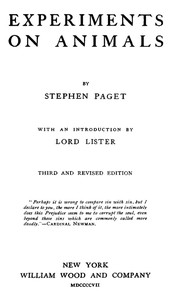
Stephen Paget's Experiments on Animals opens with a preface that establishes its origin: twelve years as Secretary to the Association for the Advancement of Medicine by Research. The book is explicitly written for general reading, not anonymous, and published without reserve. Paget states his method plainly: 'to give the original authorities, the plain facts, the very words, chapter and verse for everything.' This commitment to documentation shapes the entire work, which proceeds through detailed case studies, statistical tables, and references to contemporary medical literature.
A Defense Rooted in Documentation
Paget's preface reveals the book's defensive posture. He writes from direct experience with 'the things said by the chief opponents of all experiments on animals,' and his response is to amass evidence. The list of revisers—including Professors Rose Bradford, Starling, and Schäfer, as well as Lord Lister himself—signals the work's scientific authority. The third edition (1906) includes a reprint of Paget's pamphlet The Case against Anti-vivisection, indicating the ongoing debate. Readers should note that Paget does not argue abstractly; he builds his case through specific examples, such as the typhoid fever statistics from the 5th Battalion, Manchester Regiment, where inoculated soldiers showed a 1.5% case rate versus 4.2% among the uninoculated.
The Typhoid Fever Evidence
A substantial excerpt details the use of Widal's reaction for diagnosing typhoid fever. Paget describes the test with precision: a drop of blood diluted fifty times, mixed with living typhoid bacilli, and observed under a microscope. The bacilli's motility is 'instantaneously or very quickly arrested,' and clumping becomes visible to the naked eye. This passage illustrates Paget's strategy of translating laboratory procedures into accessible language. He cites multiple sources—Wright and Semple, Chantemesse and Widal, Pfeiffer and Kolle—to demonstrate the international scope of the research. The statistics from Winburg show three mild cases among 200 inoculated soldiers versus 23 cases and 7 deaths among 547 uninoculated, a contrast Paget uses to argue for the practical benefits of animal-based research.
The Role of Lord Lister's Introduction
Lord Lister's introduction to the first edition frames the work as 'entirely a labour of love.' Lister, a pioneer of antiseptic surgery, lends his reputation to Paget's project. The introduction likely addresses the ethical and scientific stakes of vivisection, though the excerpt does not reproduce its full text. Paget's own preface emphasizes that the book was 'a doubtful and embarrassing task,' suggesting the contentious atmosphere surrounding animal experimentation in early twentieth-century Britain. Readers should consider how Lister's endorsement functions as a rhetorical device, grounding Paget's arguments in the authority of a medical luminary.
Structure and Rhetorical Strategy
The book is divided into parts, each revised by different experts. Part I covers general principles; Part II addresses specific experiments. Paget's method is cumulative: he presents statistics, case studies, and expert testimony in a chain of evidence. The typhoid section, for example, moves from battlefield data to laboratory technique to diagnostic application, linking animal experimentation directly to human benefit. Paget avoids emotional appeals, relying instead on numbers and citations. The inclusion of a reprint of his own pamphlet suggests that the third edition aimed to consolidate arguments against anti-vivisectionist critiques. Readers should attend to how Paget structures his evidence—always returning to the 'original authorities' he promised in the preface.
Paget's book is best approached as a primary document in the history of medical ethics and science communication. Its value lies not in philosophical argument but in the density of its documentation: the names, dates, percentages, and procedures that constitute its case. Readers interested in the vivisection debates of the early 1900s will find here a meticulous, if partisan, record of how scientists defended their methods.
The rain blurred the window as I turned the pages of Paget's careful defense of vivisection, struck by how gently he framed such stark necessity. His clinical assurances made me restless, somehow. Later, shelving it, my hand caught a stranger thing—a worn treatise on mares and foals, their pains and deliveries. Complete Treatise on the mare and foal at the time of delivery, with illustrations. Also on cows and calves, with stallion and mare, when diseased by Gonorrhea (clap) or — Reading Companion, it promised. I sat down anyway, and the afternoon softened.
There are no reviews for this eBook.
Your personal reading reflection
Build a private reading journal entry for this title.