
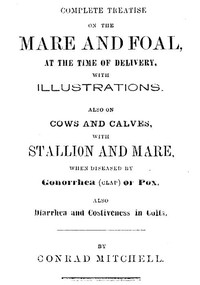
Complete Treatise on the mare and foal at the time of delivery, with illustrations. Also on cows and calves, with stallion and mare, when diseased by Gonorrhea (clap) or — Reading Companion

(0 User reviews)   739
In Category - Medicine
Mitchell, Conrad Project Gutenberg 2016 Not confirmed
Horses -- Diseases; Horses -- Breeding; Veterinary obstetrics; Veterinary gynecology; Mares; Foals Readers of public-domain and historical texts
Project Gutenberg digital edition en

Edition facts

Words 9,547
Reading time 42 min
Text sections 2

The catalog record for Complete Treatise on the mare and foal at the time of delivery, with illustrations. Also on cows and calves, with stallion and mare, when diseased by Gonorrhea (clap) or — Reading Companion provides practical reading context through 9,547 words, 42 min estimated reading time, and 2 detected text sections.

The text analysis averages about 25.5 words per sentence, while the detected sections provide another way to judge how the source is divided.

Project Gutenberg metadata also associates the work with “Horses -- Diseases,” connecting these edition facts with the source record’s subject description.

Conrad Mitchell's 1869 veterinary manual combines biblical history, clinical case notes, and home remedies for equine and bovine reproductive diseases, including gonorrhea and pox, based on his own practice.
Share
Editorial Edition Score 4.5/5

Calculated from edition completeness, EPUB availability, text structure and catalogue metadata. Not a user rating.

How this score is calculated
  • Description quality20 pts
  • Title & short description10 pts
  • Source metadata20 pts
  • Text length15 pts
  • Chapters / structure15 pts
  • EPUB file integrity20 pts

Total of 100 points, scaled to a 2.5-5.0 range. Editions with an empty description or a missing EPUB file are not scored.

Edition quality

Public-domain source text

Read the source text

The source text is kept in the dedicated reader, separate from this catalogue record and its commentary.

Conrad Mitchell opens his 1869 treatise with a sweeping biblical and geological history of the horse, citing Solomon's stables and fossil remains from Siberia to India, before abruptly shifting to a clinical case from June 1853. A stallion owned by Christian Kerr of Centre Township, Pennsylvania, presented ten ulcers on its penis, emitting a foul odor perceptible at three or four rods. Mitchell notes that existing veterinary works made 'but a single one that made the least mention of the disease, giving neither the cause or treatment.' This gap in published knowledge drives the entire volume.

Biblical Authority and Practical Observation

Mitchell's introduction draws heavily on scripture—the horse's role in the Bible, Solomon's importation from Egypt, and the Queen of Sheba's admiration—to establish the animal's dignity. Yet the excerpts show no sustained theological argument; the biblical references serve as a rhetorical prelude to his own empirical work. The catalog subjects list 'Horses—Diseases' and 'Veterinary obstetrics,' but the actual text devotes far more space to venereal diseases than to foaling. The title promises 'illustrations,' but none appear in the provided excerpts. Mitchell's authority rests on his claim to have consulted an 'eminent human Physician' and to have saved all but two mares under his care.

Gonorrhea and Pox: Diagnosis by Sight and Smell

Mitchell describes the disease in precise, sensory terms: 'small white blotches' on the stallion's penis that grow from a pin's head to a pea in days, emitting 'a very disagreeable odor.' In mares, 'blotches will appear on the shape, of a deep red color, apparently eaten through the surface of the skin,' followed by tumors 'varying from that of a pea to that of a half gallon crock.' He distinguishes gonorrhea from pox by the discharge's color and consistency—'a thin, whitish fluid, resembling bluish milk' that turns 'mattery' if pregnancy is delayed. The treatment involves chloride of lime and nitrate of silver, applied after the stallion is aroused by a mare placed 'on the other side of the fence, distant about one rod.'

Causes Rooted in Breeding Practice

Mitchell attributes the disease to overuse: a stallion covering 'five, twelve and fifteen mares a day' develops a tender, transparent penis prone to infection. He also warns against covering a mare 'on the ninth day after she has undergone the process of foaling,' when a 'discharge of bloody matter' remains. The catalog subjects include 'Horses—Breeding,' and the excerpts confirm that Mitchell's advice is inseparable from management routines. He notes that a horse covering only once every few days 'will escape unharmed.' The cause is not miasma or contagion in the modern sense but a combination of timing, frequency, and the mare's seasonal cycle.

Readers should note that the excerpts represent only the first portion of the treatise; the full work likely includes sections on cows, calves, and colt diarrhea as promised in the title. Mitchell's voice is that of a practitioner who trusts his own eyes over book learning, yet he leans on biblical and historical framing to lend weight to his observations. The text rewards attention to its concrete details—the size of ulcers, the smell at a distance, the exact mixture of lime and water—rather than its broader claims.

It’s strange what stays with you from an old text. Mitchell’s manual had this raw, clinical tenderness—him writing about sick mares as if they mattered personally. I keep thinking about that while slowly reading The genuine works of Hippocrates, Vol. 1 (of 2) — A Closer Reading. Same quiet feeling: observing bodies in distress with such earnest, careful attention. Not moralizing, just watching. It left me gentle, somehow.

There are no reviews for this eBook.

0
0 out of 5 (0 User reviews )

Add a Review

Your Rating *
There are no comments for this eBook.

Reader reflection

How did this book work for you?

Your answers remain private and are stored only in this browser.

Your progress 0 / 10
1

Which reading stage best describes you?

2

Was reading this book enjoyable?

3

Is this a title you would suggest to others?

4

How easy was the book to follow?

Related eBooks