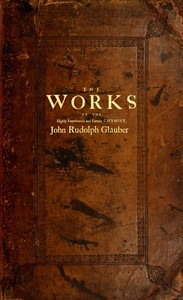
The works of the highly experienced and famous chymist, John Rudolph Glauber — Reading Companion
Edition facts
Before opening The works of the highly experienced and famous chymist, John Rudolph Glauber — Reading Companion, the edition data offers a quick orientation: 909,113 words, 65 hr 53 min estimated reading time, and 120 detected text sections.
The text analysis averages about 40.0 words per sentence, while the detected sections provide another way to judge how the source is divided.
Project Gutenberg metadata also associates the work with “Chemistry -- Early works to 1800,” connecting these edition facts with the source record’s subject description.
Calculated from edition completeness, EPUB availability, text structure and catalogue metadata. Not a user rating.
How this score is calculated
- Description quality20 pts
- Title & short description10 pts
- Source metadata20 pts
- Text length15 pts
- Chapters / structure15 pts
- EPUB file integrity20 pts
Total of 100 points, scaled to a 2.5-5.0 range. Editions with an empty description or a missing EPUB file are not scored.
Public-domain source text
Read the source text
The source text is kept in the dedicated reader, separate from this catalogue record and its commentary.
Glauber's Works opens with a detailed furnace diagram labeled in German, immediately establishing a hands-on, technical orientation. The translator, Christopher Packe, preserves this visual-verbal hybrid, signaling that the reader is expected to engage with both text and image. The title page itself is a dense catalog of contents—medicine, alchemy, mining, saltpetre, agriculture—promising a compendium of practical secrets. This blend of the empirical and the esoteric defines the work's voice.
Descriptive Precision in Furnace Design
The opening pages include a labeled illustration of an oven, with terms like "das distillier gefäs" and "die Zange mit deckel." This German terminology, left untranslated, suggests the original audience was expected to be familiar with the apparatus. Packe's English translation retains these labels, creating a bilingual technical glossary. The description of the furnace "in voller arbeit" (in full operation) emphasizes process over static design. Glauber's method is to name each part and its function, as in "der Müffel so auff den herd gehöret" (the muffle that belongs on the hearth). This attention to componentry reflects a craftsman's approach: the reader is not merely told what to do but shown the tools.
First-Person Testimony and Local Knowledge
Glauber frequently inserts himself into the narrative: "I my self have found ☉, in the lesser experiments." He names correspondents—"Mr. J. W. brought me various Ores out of the County of Eysfeldein"—and recounts specific trials, such as extracting gold from tin stone. These personal anecdotes lend credibility and a sense of ongoing investigation. He also notes failures: "this work requires such costs as far exceed the price." The voice is that of a practitioner reporting from the field, not a detached theorist. References to places like Norway, Saxony, and Westphalia ground the alchemy in real geography, and the mention of a prince who "died in his Journey homewards" adds a note of mortality to the pursuit of metallic secrets.
The Rhetoric of Hidden Treasure
Glauber's prose is punctuated by rhetorical questions and speculative asides: "Who knows but that that same place which we call Velaw hides in it vast Treasures." This phrasing transforms mineralogy into a kind of treasure hunt. He describes finding "a white Clay and Earth out of which I extracted some ☽" (silver) near Arnheim, but admits he has not tested nearby iron veins. The conditional mood—"whether or no they contain ☉ and ☽ I cannot tell"—acknowledges the limits of his knowledge while inviting further exploration. Such passages blend empirical report with the allure of the unknown, a characteristic tension in early modern chymistry.
Translation as Interpretation: Packe's Role
Christopher Packe's translation is not a neutral rendering. He adds a subtitle promising "Great Variety of Choice Secrets" and frames the work as published "for Publick Good." The preface and subscriber list (not excerpted here) indicate a communal, patronage-based readership. Packe's own title, "Philo-chymico-Medicus," signals his alignment with both medicine and alchemy. In the text, he retains alchemical symbols (☉ for gold, ☽ for silver) and Latin terms like aureous, preserving the specialized lexicon. His choices shape how Glauber's practical instructions are received: as both a manual and a philosophical testament.
Readers approaching this volume should attend to the interplay between the concrete and the conjectural. Glauber's detailed descriptions of furnaces and ores sit alongside speculative passages about hidden treasures. The work rewards a slow reading that follows the chain of evidence—from labeled diagrams to personal testimony—without expecting a unified theory. Packe's translation, with its period typography and alchemical symbols, is itself a historical artifact worth examining.
There’s something tender about Glauber’s insistence on showing his work, step by step, as if trusting a future stranger with his hardest-won habits. That same quiet faith in the reader lingers in A reference hand-book for nurses — Key Ideas to Explore, where the care feels less like teaching and more like passing on a steadiness. I keep thinking how both books ask for patience, then reward it gently.
There are no reviews for this eBook.
Record your reading impressions
A brief reflection can help important ideas stay with you longer.