
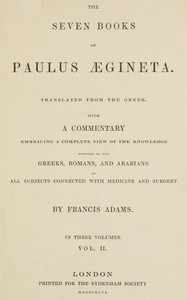
The seven books of Paulus Ægineta, volume 2 (of 3) — A Reader’s Guide
Edition facts
This digital edition of The seven books of Paulus Ægineta, volume 2 (of 3) — A Reader’s Guide is described by source-level measurements including 198,049 words, 14 hr 22 min estimated reading time, and 20 detected text sections.
The text analysis averages about 21.9 words per sentence, while the detected sections provide another way to judge how the source is divided.
Project Gutenberg metadata also associates the work with “Medicine,” connecting these edition facts with the source record’s subject description.
Calculated from edition completeness, EPUB availability, text structure and catalogue metadata. Not a user rating.
How this score is calculated
- Description quality20 pts
- Title & short description10 pts
- Source metadata20 pts
- Text length15 pts
- Chapters / structure15 pts
- EPUB file integrity20 pts
Total of 100 points, scaled to a 2.5-5.0 range. Editions with an empty description or a missing EPUB file are not scored.
Public-domain source text
Read the source text
The source text is kept in the dedicated reader, separate from this catalogue record and its commentary.
The second volume of Francis Adams' translation of Paulus Aegineta opens with the fourth book, a systematic catalogue of skin diseases, wounds, and surgical procedures. The translator's voice is immediately present: the Greek text is rendered in clear, clinical English, while the accompanying commentary draws on a wide range of ancient and medieval authorities, from Hippocrates to Avicenna. The excerpts reveal a work that moves between two registers—the concise, imperative style of the original surgical instructions and the expansive, comparative tone of Adams' footnotes.
Precision in Surgical Description
The surgical passages in this volume are marked by a careful, almost geometric attention to detail. In the operation for distichiasis (ingrown eyelashes), the text describes a lunated incision that produces a flap having the shape of a myrtle leaf. The steps are numbered: first the under-incision, then the curved cut, then the use of a hook (tenaculum) to dissect the skin. Sutures are placed beginning at the middle, and the thread is left three fingers' breadth long. This level of specificity suggests a written tradition that aimed to be replicable, not merely descriptive.
Yet the text also records variations. Paulus notes that some practitioners avoid dissecting the skin, instead stretching the fold with forceps and cutting it off. Another method uses reeds or plates tied with ligatures to let the skin die and fall off over ten to fifteen days. These alternatives are presented without judgment, as a repertoire of choices rather than a single correct method.
The Commentary as a Second Voice
Adams' commentary does not simply explain the Greek; it creates a parallel text. For the eyelid surgery, he cross-references Aëtius, Celsus, Albucasis, Rhases, Avicenna, Avenzoar, Serapion, Mesue, Jesu Hali, Canamusali, Haly Abbas, and Vegetius. This list is not ornamental—it shows that the translator sees Paulus as one node in a network of medical writers spanning centuries and cultures. The commentary often abridges or paraphrases these sources, as when he gives an abridged account of Aëtius' version, noting that Aëtius recommends two assistants instead of one and marking the skin with ink beforehand.
This comparative method changes the pace of reading. The main text moves briskly through procedures; the commentary slows down, adding historical depth and alternative techniques. The reader is invited to see each operation not as a fixed protocol but as a practice that evolved through transmission and adaptation.
Shifts in Pace Between Text and Apparatus
The volume's structure creates a rhythm of acceleration and deceleration. The table of contents lists over fifty sections in the fourth book alone, covering topics from elephantiasis to hemorrhoids. Each section is brief—often a few paragraphs—and follows a formula: definition, causes, symptoms, treatment. This rapid succession of topics gives a sense of encyclopedic coverage.
But the commentary interrupts this flow. A short section on burns might generate a long footnote citing multiple authorities. The reader must toggle between the compressed Greek original and the expansive Victorian commentary. This dual pace is not a flaw but a feature: it mirrors the dual purpose of the Sydenham Society edition, which aimed to present both the ancient text and a modern scholarly apparatus. The result is a work that can be read straight through for its practical content or studied slowly for its intellectual history.
Readers approaching this volume should be prepared for two intertwined texts: Paulus' concise Greek medicine and Adams' erudite Victorian commentary. The surgical passages reward close reading for their technical vocabulary and procedural logic, while the footnotes offer a window into how ancient knowledge was collected, compared, and transmitted. The volume is best used as a reference work, but its layered structure also invites browsing—one can start with a single section and follow the commentary's threads across centuries of medical writing.
Paul of Aegina’s old pages still carry the warmth of someone noting, case by case, that bodies mend in their own time. That quiet patience—watching, waiting, recording—is the very kinship I feel in The Home Medical Library, Volume 1 (of 6) — Reading Companion, where the voice is gentler but the same steady hand is there, caring for the ordinary hurts.
There are no reviews for this eBook.
Before you leave, reflect on the book
Use these questions to collect your thoughts before moving on.