
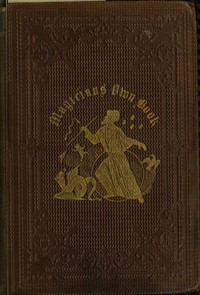
The Magician's Own Book, or, the Whole Art of Conjuring by Arnold and Cahill
Let's be clear from the start: this isn't a storybook. The Magician's Own Book is exactly what its title promises—a complete guide to performing magic tricks, published in 1857. Compiled by Frank Cahill, it pulls together the best conjuring secrets of the age. Think of it as the ultimate DIY kit for aspiring wizards of the Victorian era.
The Story
There's no traditional plot here. Instead, the 'narrative' is your journey from novice to knowledgeable performer. The book is structured like a course. It starts with the absolute basics: how to palm a coin, the essential grips for cards. Then, it builds up to elaborate routines involving cups and balls, mind reading, and even tricks with live animals. Each trick is laid out with a list of needed props, step-by-step instructions for the performance, and the crucial explanation of the method—the 'how it's done.' The 'characters' are the tricks themselves, from the simple 'Vanishing Coin' to the complex 'Enchanted Walnuts.'
Why You Should Read It
I loved this book for its window into a different time. The language is formal yet earnest, with the authors genuinely wanting to share these arts. It's a hands-on history lesson. You get a real sense of what entertained people in drawing rooms before movies or video games. More than that, it demystifies magic in a wonderful way. Seeing the mechanics—often relying on simple physics, psychology, and sheer practice—makes the art form more impressive, not less. It shifts magic from something 'supernatural' to a testament to human cleverness and dexterity. Reading the careful instructions, you can almost hear the rustle of heavy curtains and the gasps of a delighted audience.
Final Verdict
This book is a niche gem, but a brilliant one. It's perfect for history buffs, magic enthusiasts, or anyone with a curious mind about how things work. It's not a page-turner in the classic sense, but it's incredibly absorbing if you're in the right headspace. Aspiring magicians will find a treasure trove of classic routines. For everyone else, it's a unique and charming artifact—a direct conversation with the past that teaches you how to make a handkerchief defy gravity. Just don't blame me if you start carrying a deck of cards everywhere.
No rights are reserved for this publication. Distribute this work to help spread literacy.







Donald Thompson
7 months agoHonestly, the author's voice is distinct and makes complex topics easy to digest. Worth every second.