
Medical Thoughts of Shakespeare — A Reader’s Guide

(0 User reviews)   4067
In Category - Medicine
Field, Benjamin Rush, 1861-1935 Project Gutenberg 2020 Not confirmed
Medicine in literature; Shakespeare, William, 1564-1616 -- Knowledge -- Medicine; Literature and medicine -- England -- History -- 16th century; Literature and medicine -- England -- History -- 17th century Readers of public-domain and historical texts
Project Gutenberg digital edition en

Edition facts

Words 28,457
Reading time 124 min
Text sections 10

Before opening Medical Thoughts of Shakespeare — A Reader’s Guide, the edition data offers a quick orientation: 28,457 words, 2 hr 4 min estimated reading time, and 10 detected text sections.

The text analysis averages about 15.9 words per sentence, while the detected sections provide another way to judge how the source is divided.

Project Gutenberg metadata also associates the work with “Medicine in literature,” connecting these edition facts with the source record’s subject description.

Benjamin Rush Field's 1885 study catalogs Shakespeare's medical references, organized by specialty. The second edition adds chapters on surgery, physiology, anatomy, and pharmacy, with over 400 new quotations. Field treats the plays as clinical evidence, tracing diagnoses from syphilis to consumption without claiming Shakespeare was a physician.
Share
Editorial Edition Score 4.7/5

Calculated from edition completeness, EPUB availability, text structure and catalogue metadata. Not a user rating.

How this score is calculated
  • Description quality20 pts
  • Title & short description10 pts
  • Source metadata20 pts
  • Text length15 pts
  • Chapters / structure15 pts
  • EPUB file integrity20 pts

Total of 100 points, scaled to a 2.5-5.0 range. Editions with an empty description or a missing EPUB file are not scored.

Edition quality

Public-domain source text

Read the source text

The source text is kept in the dedicated reader, separate from this catalogue record and its commentary.

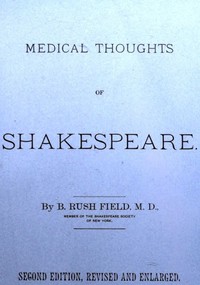
Benjamin Rush Field, a physician and member of the Shakespeare Society of New York, approaches the plays not as literary texts but as a repository of early modern medical knowledge. His 1885 second edition, revised and enlarged, organizes hundreds of quotations under headings such as “The Physician,” “Surgery,” and “Obstetrics,” treating Shakespeare’s lines as clinical evidence. Field’s preface notes that the labor was “entirely of the leisure hours of the night,” and he adds chapters on physiology, anatomy, and pharmacy, along with medical thoughts from other authors like Byron and Swift. The result is a taxonomic work that reads Shakespeare’s characters as case studies, diagnosing Falstaff with syphilis and tracing curses in Timon of Athens to specific symptoms.

A Physician’s Taxonomy of the Plays

Field’s table of contents reads like a medical textbook: Part I, “The Physician”; Part II, “Practice of Medicine,” subdivided by bodily system; Part III, “Surgery”; Part IV, “Obstetrics”; Part V, “Physiology”; Part VI, “Anatomy”; Part VII, “Pharmacy.” Each section collects quotations under subheadings such as “Diseases of the Nervous System” or “Syphilis.” Field does not argue for a unified theory of Shakespeare’s medical knowledge; instead, he catalogs, letting the lines speak as evidence. For instance, under “Syphilis,” he groups passages from Pericles, Henry V, Measure for Measure, and Timon of Athens, noting that “the symptoms of secondary and tertiary syphilis are accurately expressed” in Timon’s curse. Field’s method is associative: he links “hoar the flamen” to leprosy, “down with the nose” to syphilitic collapse, and “consumptions sow” to tuberculosis, calling these “maladies that are hereditary, incurable, and contagious.” The organization imposes a clinical grid on dramatic speech, treating each quotation as a specimen.

The Surgeon’s Knife and the Lawyer’s Brief

Field occasionally steps back from cataloging to note Shakespeare’s verbal precision. In the section on syphilis, he quotes Byron’s couplet—“The lawyer’s brief is like the surgeon’s knife / Dissecting the whole inside of a question”—as an epigraph, but his own commentary is spare. He observes that Shakespeare “shows a very fine point” in grouping leprosy, syphilis, and consumption in Timon’s curse, because all three are “lasting.” Field also draws on contemporary medical authorities: he cites Dr. Macdonnell of Canada on the “tub-fast” treatment for syphilis, explaining that patients were placed in a tub for prolonged diaphoresis and low diet. This move—linking a line from Measure for Measure (“she is herself in the tub”) to a specific therapeutic practice—exemplifies Field’s method. He reads the plays as documentary evidence of early modern medicine, not as metaphor. The result is a work that is part concordance, part medical history, and part homage to Shakespeare’s observational range.

The Limits of a Clinical Reading

Field’s approach has clear boundaries. He does not claim that Shakespeare was a physician, only that his “mighty mind seems to have teemed with the knowledge of languages, medicine, law and court etiquette.” The excerpts show Field treating dramatic dialogue as transparent reportage: when Falstaff says “the pox pinches the other,” Field takes it as a reference to syphilis; when the gravedigger in Hamlet speaks of “pocky corses,” Field reads it as evidence of contemporary mortality. Yet the plays are fictions, and characters’ statements are not necessarily Shakespeare’s own beliefs. Field’s book is valuable as a record of what a late-nineteenth-century physician saw in the texts, but it does not distinguish between a character’s voice and the author’s knowledge. Readers should approach the quotations as Field did—as raw material for a medical taxonomy—while remembering that Shakespeare’s first purpose was dramatic, not diagnostic.

Field’s Medical Thoughts of Shakespeare is best read as a period piece: a physician’s systematic collection of medical references from the plays, organized by specialty and annotated with contemporary medical commentary. It offers a unique window into how a late-nineteenth-century doctor read Shakespeare, but it does not provide literary analysis or historical context for early modern medicine. For modern readers, the value lies in the quotations themselves and in Field’s implicit argument that Shakespeare’s language can be mapped onto a clinical grid—an argument that reveals as much about the cataloger as the cataloged.

That rainy afternoon, I lingered over Field’s quiet gleanings from Shakespeare—how the plays catalogued fever and fracture with such plain fondness. The clinical tenderness made me wonder about inheritance itself, what passes down through bodies. Later, almost by accident, I found Some possible bearings of genetics on pathology — Reading Notes, and it felt like the same rain, falling on different ground.

There are no reviews for this eBook.

0
0 out of 5 (0 User reviews )

Add a Review

Your Rating *
There are no comments for this eBook.

Reader reflection

Record your reading impressions

A brief reflection can help important ideas stay with you longer.

Your progress 0 / 10
1

What is your current status with this title?

2

Was reading this book enjoyable?

3

Is this a title you would suggest to others?

4

How easy was the book to follow?

Related eBooks