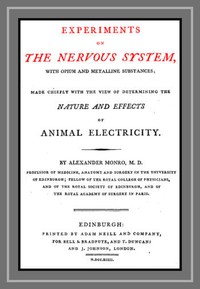
Experiments on the Nervous System with Opium and Metalline Substances Made Chiefly with the View of Determining the Nature and Effects of Animal Electricity — Reading Notes

(0 User reviews)   267
In Category - Medicine
Monro, Alexander, 1733-1817 Project Gutenberg 2014 Not confirmed
Electrophysiology -- Early works to 1800; Nervous system -- Experiments -- Early works to 1800; Frogs -- Physiology Readers of public-domain and historical texts
Project Gutenberg digital edition en

Edition facts

Words 10,103
Reading time 44 min
Text sections 2

The source record for Experiments on the Nervous System with Opium and Metalline Substances Made Chiefly with the View of Determining the Nature and Effects of Animal Electricity — Reading Notes measures this digital text at 10,103 words, 44 min estimated reading time, and 2 detected text sections.

The text analysis averages about 33.6 words per sentence, while the detected sections provide another way to judge how the source is divided.

Project Gutenberg metadata also associates the work with “Electrophysiology -- Early works to 1800,” connecting these edition facts with the source record’s subject description.

Alexander Monro's 1793 experiments on frogs test whether opium and metals reveal an electrical fluid in nerves. Detailed procedures, chain reactions, and comparisons with electricity challenge the nervous fluid theory.
Share
Editorial Edition Score 4.4/5

Calculated from edition completeness, EPUB availability, text structure and catalogue metadata. Not a user rating.

How this score is calculated
  • Description quality20 pts
  • Title & short description10 pts
  • Source metadata20 pts
  • Text length15 pts
  • Chapters / structure15 pts
  • EPUB file integrity20 pts

Total of 100 points, scaled to a 2.5-5.0 range. Editions with an empty description or a missing EPUB file are not scored.

Edition quality

Public-domain source text

Read the source text

The source text is kept in the dedicated reader, separate from this catalogue record and its commentary.

Alexander Monro's 1793 treatise opens with a striking methodological confession: he began his experiments on animal electricity in November, hurried and short of frogs, and only later prosecuted the subject 'more fully and with greater attention.' This candid admission sets the tone for a work that is as much about experimental design as about physiological theory. Monro, a professor of medicine, anatomy, and surgery in Edinburgh, aims to determine whether the fluid set in motion by metals resembles the electrical fluid—and whether it is identical to the nervous fluid or energy.

Frogs as Living Instruments

Monro's primary subjects are frogs, and he devotes careful preliminary observations to their circulatory and nervous systems. He notes that the frog's heart consists of one auricle and one ventricle, contracting about sixty times per minute, and that after the heart is cut out, a frog can still crawl or jump for over an hour. This resilience makes frogs ideal for experiments that require repeated stimulation. Monro also describes the encephalon: the brain and cerebellum are each divided into two hemispheres, conjoined below by thick crura forming the medulla oblongata. These anatomical details are not mere background; they underpin the experimental logic, as Monro later severs spinal cords or isolates nerves to trace the path of the suspected electrical influence.

Metallic Chains and Concentrated Influence

Monro's experiments often involve arranging frogs in chains. In one series, he cuts frogs transversely at the middle of the spine and places the hind parts in contact, applying gold and zinc to trigger convulsions. He observes that when the influence is 'concentrated in the Nerve,' convulsions occur; when it is 'diffused' through other organs, they do not. This distinction is critical: Monro is not merely demonstrating a phenomenon but isolating the nerve as the specific conductor. He also notes that after repeated convulsions, a frog's legs weaken but recover within minutes, suggesting a temporary depletion of some vital principle. In another experiment, he passes a gold wire between the sciatic nerves and sacrum, then places the frog in a zinc vessel; every time the animal moves and brings gold and zinc into contact, its hind legs convulse. After three or four days, the limbs are weakened but not exhausted, and they recover after the wire is removed.

Comparing Metals and Electricity

Monro explicitly compares the convulsions produced by metals with those from electrical shocks. He finds that slight electrical shocks or a Leyden phial discharge through the limbs produce convulsions 'exactly resembling those excited by the Metals.' Moreover, after moderate electrical shocks have been passed repeatedly through the legs, applying the metals still provokes convulsions. He also tests whether electrical shocks are conducted by nerves after they have been cut and tied together, confirming that they are. These comparisons are central to Monro's argument: the fluid put in motion by metals behaves like electricity, yet he concludes that it is not the same as the nervous fluid or energy. The evidence from the excerpts does not reveal his full reasoning for this distinction, but the experimental parallels are meticulously drawn.

Monro's work is best approached as a record of experimental reasoning rather than a finished theory. Readers will find detailed procedures, repeated trials, and careful controls—such as cutting nerves to test conduction or varying the arrangement of frog chains. The excerpts show a scientist attentive to variables like the concentration of influence and the recovery of muscle strength. Pay attention to how Monro uses negative results (e.g., when convulsions do not occur) to refine his understanding of the nerve's role. The treatise rewards those who follow the logic of each experiment step by step.

There’s something touching in old Monro’s frog legs, twitching under opium, chasing a spark that never quite arrived. It feels like paging through someone’s patient hope. I find a quieter echo of that same earnest curiosity in the hard-won candor of Plain Facts for Old and Young — Inside the Classic, where honesty itself becomes the experiment.

There are no reviews for this eBook.

0
0 out of 5 (0 User reviews )

Add a Review

Your Rating *
There are no comments for this eBook.

Reader reflection

Your personal reading reflection

Build a private reading journal entry for this title.

Your progress 0 / 10
1

Have you finished this book?

2

How did the book work for you overall?

3

Would you pass this book on to a friend?

4

How easy was the book to follow?

Related eBooks