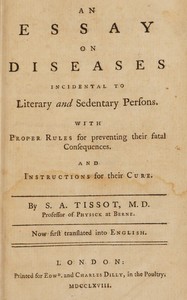
An essay on diseases incidental to literary and sedentary persons — Edition Insights
Edition facts
The catalog record for An essay on diseases incidental to literary and sedentary persons — Edition Insights provides practical reading context through 27,026 words, 1 hr 58 min estimated reading time, and 7 detected text sections.
The text analysis averages about 37.1 words per sentence, while the detected sections provide another way to judge how the source is divided.
Project Gutenberg metadata also associates the work with “Medicine, Popular -- Early works to 1800,” connecting these edition facts with the source record’s subject description.
Calculated from edition completeness, EPUB availability, text structure and catalogue metadata. Not a user rating.
How this score is calculated
- Description quality20 pts
- Title & short description10 pts
- Source metadata20 pts
- Text length15 pts
- Chapters / structure15 pts
- EPUB file integrity20 pts
Total of 100 points, scaled to a 2.5-5.0 range. Editions with an empty description or a missing EPUB file are not scored.
Public-domain source text
Read the source text
The source text is kept in the dedicated reader, separate from this catalogue record and its commentary.
Tissot opens his address to the magistrates of Berne with elaborate gratitude, framing his medical discourse as a public duty. The work quickly shifts from ceremonial praise to a blunt assessment: most studious men, he claims, waste their time and ruin their constitutions on trivial pursuits. This moralizing tone pervades the excerpts, where Tissot positions himself as a monitor who must 'knock at their doors' and force scholars to exercise. The catalog lists 'occupational diseases' and 'popular medicine' as subjects, but the text itself is less a clinical manual than a rhetorical performance—part lecture, part sermon—aimed at reforming habits through shame and classical example.
The Moral Framework of Medical Advice
Tissot's diagnosis of scholarly ailments is inseparable from his judgment of scholarly character. He catalogues the excuses the learned use to avoid exercise: confidence in strength, hope of impunity, the 'deceitful defence of the power of habit,' and the example of others' luck. These are not physiological but moral failings. The physician's role, as Tissot presents it, is to 'neglect my duty as a monitor'—a word that echoes his earlier self-description as a public servant. The catalog subject 'Medicine, Popular' suggests a lay audience, but Tissot's tone is often scolding, as when he declares that most studious men 'lose their time, and break their constitutions to no purpose.' The medical advice is embedded in a framework of virtue and utility, where only a few—Descartes, Newton, Montesquieu—are exempt from the rule that the mind must be 'often unemploy'd.'
Exercise as Classical Prescription
The excerpts devote considerable space to exercise, but Tissot's recommendations are grounded in ancient authority rather than empirical observation. He cites Herodicus, who 'by exercise alone so confirmed his health, that he lived entirely free from disorders to a hundred years'; Socrates, who 'thought it worth his while to learn this art'; and Hysmonaeus, who overcame nervous weakness through the Olympic games. Walking, riding, sailing—each is praised for its effects on specific organs: walking 'recreates the lungs,' riding 'acts admirably upon the head and lungs, and above all upon the abdominal viscera.' Yet Tissot offers no case studies from his own practice, nor does he detail the diseases he claims to treat. The catalog subject 'Occupational diseases' implies a systematic nosology, but the excerpts show a physician more interested in moral exhortation and classical citation than in clinical description.
The Limits of the Excerpts: What Is Missing
The excerpts provide only the dedication, the advertisement to the reader, and a portion of the main text on exercise. Missing are Tissot's specific descriptions of diseases—the 'fatal consequences' promised in the subtitle—and his instructions for cure. The catalog subjects lead one to expect a medical taxonomy of conditions like hypochondria, dyspepsia, or nervous disorders, but the surviving text emphasizes prevention through regimen. Tissot mentions 'the spleen' and 'weakness of the nerves' only in passing, as conditions cured by exercise in ancient figures. Without the full text, it is impossible to assess whether Tissot's work aligns with the catalog's implication of a systematic occupational medicine, or whether the moralizing tone dominates throughout. Readers should approach the work as a hybrid: part medical treatise, part conduct book, with its classical learning and rhetorical structure shaping the advice as much as any clinical evidence.
Tissot's essay resists easy classification. It is neither a dry medical textbook nor a mere popular health guide, but a work that uses the authority of antiquity to argue for a disciplined life. Readers will find the most concrete advice in the passages on exercise, but the text's real interest lies in its portrait of the scholar as a creature of habit and self-deception. The catalog subjects are a starting point, not a summary.
There’s something tender about Tissot’s worry for us—those who sit too long with our thoughts, forgetting the body entirely. I kept thinking of that while revisiting Bodily changes in pain, hunger, fear, and rage — Inside the Classic; the old ache feels familiar, a quiet companion across centuries. We never quite learn to stand up, do we?
There are no reviews for this eBook.
Record your reading impressions
A brief reflection can help important ideas stay with you longer.