
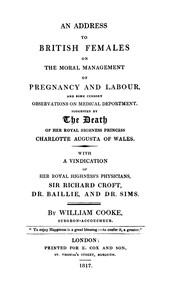
An address to British females on the moral management of pregnancy and labour, and some cursory observations on medical deportment — Inside the Classic
Edition facts
This digital edition of An address to British females on the moral management of pregnancy and labour, and some cursory observations on medical deportment — Inside the Classic is described by source-level measurements including 10,964 words, 48 min estimated reading time, and 5 detected text sections.
The text analysis averages about 25.8 words per sentence, while the detected sections provide another way to judge how the source is divided.
Project Gutenberg metadata also associates the work with “Obstetrics,” connecting these edition facts with the source record’s subject description.
Calculated from edition completeness, EPUB availability, text structure and catalogue metadata. Not a user rating.
How this score is calculated
- Description quality20 pts
- Title & short description10 pts
- Source metadata20 pts
- Text length15 pts
- Chapters / structure15 pts
- EPUB file integrity20 pts
Total of 100 points, scaled to a 2.5-5.0 range. Editions with an empty description or a missing EPUB file are not scored.
Public-domain source text
Read the source text
The source text is kept in the dedicated reader, separate from this catalogue record and its commentary.
William Cooke, a surgeon-accoucheur, published this pamphlet in 1817, prompted by the death of Princess Charlotte Augusta of Wales after childbirth. The work is explicitly extemporaneous, as Cooke states in the Advertisement, written under circumstances that forbade delay. It aims to address British females on the moral management of pregnancy and labour, while also offering a vindication of the princess's physicians—Sir Richard Croft, Dr. Baillie, and Dr. Sims—whom Cooke did not know personally. The text blends practical obstetric advice with reflections on the influence of mind over body, a theme Cooke returns to repeatedly.
Moral Agency and the Limits of Medicine
Cooke frames his address around moral agency, distinguishing it from a purely medical treatise. He argues that the mind exerts a powerful influence on the body, citing examples such as blushing affecting the circulatory system and anxiety causing loss of appetite. He writes that until the association of mind and body is better understood, the extent of moral influence cannot be appreciated. This leads him to assert that attempts to relieve suffering by medicine alone will often end in disappointment. The pamphlet thus positions emotional and psychological care as essential to obstetric practice, not merely an adjunct.
Practical Guidance on Miscarriage and Child-bed Fever
Cooke offers specific advice on managing miscarriage and child-bed fever. He notes that miscarriage can become habitual, recurring at the same stage of conception across multiple pregnancies. For such cases, he emphasizes the urgent need to attend to the patient's mental state, as her life may be a series of suffering and anxiety. On child-bed fever, he recommends early and free bleeding and purging, with strict low diet. He also warns against using spirits in washing newborns, as their rapid evaporation produces intense cold. These instructions are grounded in the medical understanding of the era, without claiming certainty.
The Vindication of Princess Charlotte's Physicians
A significant portion of the pamphlet is devoted to defending Sir Richard Croft, Dr. Baillie, and Dr. Sims against public criticism following the princess's death. Cooke states his vindication is disinterested, as the physicians are unknown to him. He argues that the general sensation and acute sensibility surrounding the tragedy led to unfair judgment. The text does not detail the events of the princess's labour or the physicians' actions, but Cooke insists on the propriety of their conduct. This section reveals the pamphlet's dual purpose: to instruct and to rehabilitate reputations.
Readers should approach this pamphlet as a period document that reveals early 19th-century attitudes toward pregnancy, the role of emotion in health, and the public scrutiny of medical practitioners. Cooke's insistence on moral management and his defense of the princess's physicians are intertwined, reflecting a moment when obstetric care was both a medical and a social concern. The text rewards attention to its rhetorical strategies and its attempt to balance instruction with advocacy.
I keep thinking about that old pamphlet, how it worried over the invisible thread between a mother’s mind and her body. It felt less like advice and more like a quiet hand on the shoulder. Something in Keeping fit all the way — Context and Discussion nudged that same memory, gently, as if we’d once walked that path together.
There are no reviews for this eBook.
Take a moment to reflect on this book
Create a short personal record of your experience with this book.