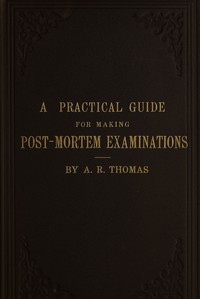
A practical guide for making post-mortem examinations — Edition Insights
Edition facts
For A practical guide for making post-mortem examinations — Edition Insights, the stored edition analysis reports 98,293 words, 7 hr 8 min estimated reading time, and 18 detected text sections.
The text analysis averages about 22.5 words per sentence, while the detected sections provide another way to judge how the source is divided.
Project Gutenberg metadata also associates the work with “Autopsy -- Handbooks, manuals, etc.,” connecting these edition facts with the source record’s subject description.
Calculated from edition completeness, EPUB availability, text structure and catalogue metadata. Not a user rating.
How this score is calculated
- Description quality20 pts
- Title & short description10 pts
- Source metadata20 pts
- Text length15 pts
- Chapters / structure15 pts
- EPUB file integrity20 pts
Total of 100 points, scaled to a 2.5-5.0 range. Editions with an empty description or a missing EPUB file are not scored.
Public-domain source text
Read the source text
The source text is kept in the dedicated reader, separate from this catalogue record and its commentary.
A. R. Thomas’s 1873 manual opens with a preface that explicitly disclaims completeness, positioning itself as a practical aid for practitioners and students. The work is divided into four parts—Head, Chest, Abdomen, and a miscellaneous section covering bones, joints, tumors, poisons, medico-legal autopsies, embalming, and specimen preservation. The author’s voice is direct and instructional, often addressing the reader as “you” in procedural steps, yet the excerpts reveal a careful balance between general guidance and specific pathological detail.
The language shifts between terse procedural notes and fuller clinical descriptions, as seen in the liver cancer cases where Thomas narrates patient histories with a physician’s eye for symptom progression. This dual register—part handbook, part casebook—gives the text a distinctive rhythm, moving from abstract rules to concrete examples without losing focus on the practical task at hand.
A Voice of Practical Authority
Thomas’s narrative voice is that of an experienced teacher, not a distant encyclopedist. He writes with a sense of urgency and directness: “The following work has been prepared with a view of supplying a want, the existence of which has long been felt by the author.” This opening establishes a personal stake. Throughout the excerpts, he uses second-person constructions sparingly but effectively, as when he notes that certain characters “will usually enable us to make a correct diagnosis.” The “us” includes the reader in the diagnostic process.
His prose is clinical but not cold. Descriptions of cancerous masses as “light, straw-colored” or “of the consistence of tallow or cheese” rely on everyday analogies, making the unfamiliar tangible. The author’s voice also reveals his institutional context: references to the Hahnemann College Museum and acknowledgments to colleagues underscore that this guide emerges from a specific medical community—homeopathic—though the methods described are broadly anatomical.
Structure as a Pedagogical Tool
The book’s organization mirrors a logical autopsy sequence: head, chest, abdomen. Each part likely follows a similar pattern—external inspection, layer-by-layer dissection, organ-by-organ examination. The preface outlines this tripartite structure, and the liver cancer section shows how Thomas integrates case studies into the systematic framework. Case I, for instance, begins with a patient history, then moves to autopsy findings, demonstrating how clinical observation leads to post-mortem confirmation.
This alternation between general rules and specific cases creates a rhythm of abstraction and application. Thomas does not simply list pathological appearances; he shows how to recognize them in context. The inclusion of differential diagnoses—such as distinguishing cancerous from waxy liver enlargement—adds a layer of clinical reasoning. The structure thus serves not only as a reference but as a training tool for diagnostic thinking.
Precision in Pathological Description
Thomas’s descriptive language is remarkably precise, often quantifying or qualifying observations. He notes that in ninety-one cases of liver cancer collected by Frerichs, fifty-two showed no jaundice—a statistical detail that grounds his advice in evidence. He describes cancerous masses as “varying in size from a kernel of corn to an orange,” using familiar objects for scale. The interior of these masses is “whitish-gray” with “the consistence of tallow or cheese,” and on close examination, “the substance has the appearance of infinitely minute granules, aggregated together.”
Such specificity extends to clinical signs: pain “in paroxysms, resembled much the pain attending the passage of biliary calculi.” Thomas also notes rare variations, such as infiltrated rather than massed cancerous matter, and warns of potential confusion with waxy degeneration. This attention to nuance—and to sources of error—reflects the manual’s practical aim: to equip the reader with reliable, actionable criteria.
Readers approaching this guide should attend to the interplay between its systematic structure and the author’s clinical voice. Thomas’s reliance on case examples, comparative diagnostics, and precise analogies makes the text more than a checklist—it is a window into nineteenth-century pathological reasoning. For those studying the history of medicine or autopsy technique, the manual offers a grounded, evidence-rich perspective, best read with attention to how Thomas balances generality with particularity.
There’s something oddly tender about that old manual’s insistence on careful, hands-on method—like a friend steadying your hand. It reminded me of the quiet way Keeping fit all the way treats the body’s daily upkeep as a kind of gentle ritual. I thought of you when I set it down, how some books stay with you without asking for anything. That one did. Keeping fit all the way — Context and Discussion
There are no reviews for this eBook.
Record your reading impressions
A brief reflection can help important ideas stay with you longer.